
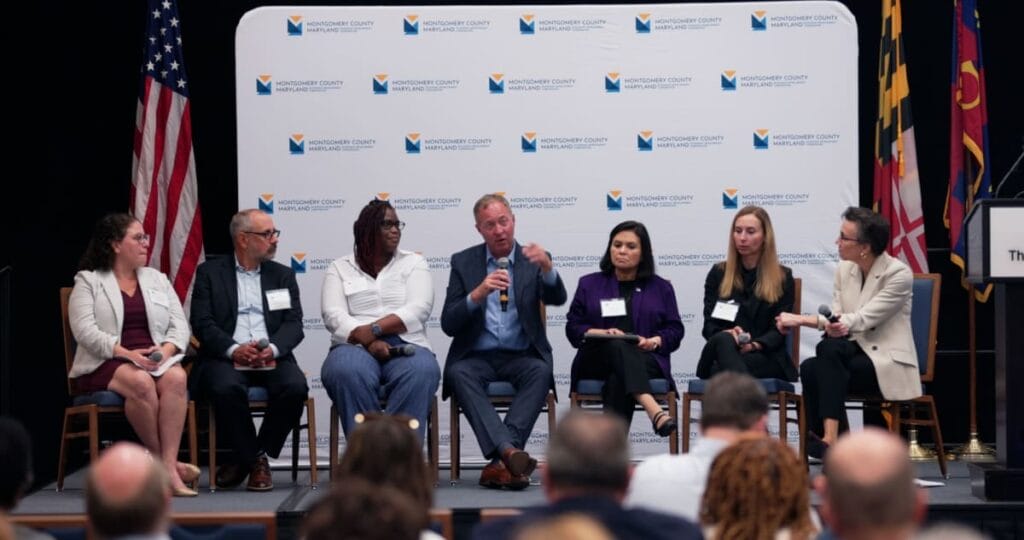
Talent is one of the most important factors influencing where companies choose to invest, expand, and grow. As competition for skilled workers intensifies, employers are embracing a broader talent strategy: one that leverages partnerships. Last week, almost 120 business leaders, elected officials, and members of Montgomery County’s business community attended the Montgomery County Economic Development Corporation’s (MCEDC) panel, “The Talent Advantage: A Growth Strategy for Companies in Montgomery County, Maryland,” to hear how local businesses are capitalizing on the County’s world-class academic institutions, innovation ecosystem, quality of life, and economic development resources to attract and retain top talent.
Moderated by Dr. Anne Khademian, Executive Director at The Universities at Shady Grove (USG), the panel included executives from businesses and institutions across industries, including Lockheed Martin, TrilliumBIO, Thales Defense & Security, Johns Hopkins, Montgomery College, and AstraZeneca, who discussed their companies’ strategies for developing their workforce.
Talent as a Business Strategy
For companies competing in highly specialized industries like the defense industry, access to talent directly influences where they choose to locate and grow. For Lockheed Martin, which employs nearly 1,000 people in Montgomery County, talent is one of the primary reasons the company chose to be headquartered here.
“Talent is in the top one or two reasons why we are in the County,” said Todd Cohen, Senior Lead of Strategic Workforce Development, Lockheed Martin.
According to Cohen, Lockheed Martin begins working with partners to develop their talent pipeline well before students enter the workforce, including partnering with Montgomery County Public Schools (MCPS) on programs such as coding challenges. Lockheed Martin also maintains close relationships with local higher education institutions, including the Universities at Shady Grove (USG).
That local talent pipeline is also an important factor for AstraZeneca, which employs more than 5,000 employees and contractors in Montgomery County. According to Tiffany Lukis, Director of STEM and Community Engagement at AstraZeneca, the company often taps into its alumni base from Montgomery College (ranked #26 nationally among community colleges) and USG (which offers nine different public universities onto one campus), and other local institutions to fill highly technical roles.
Local Companies Are Developing Talent and Not Just Finding It
According to the panelists, investing in existing employees is just as important as recruiting new ones.
At Suburban Hospital, workforce development is closely tied to talent retention. The hospital partners with local educational institutions to provide employees with opportunities to gain new skills and advance their careers. Programs include a Certified Nursing Assistant program through Montgomery College and English as a Second Language classes.
“A huge part of our talent strategy is to prioritize holding on to our top tier talent,” said Corey Lewson, MSW, Program Manager, Workforce Development, John Hopkins Medicine.
For smaller companies, developing talent internally can be especially valuable. Lane Edwards, Vice President of Operations, TrilliumBIO, a biomarker discovery company with fewer than 20 employees based in Rockville, described the challenge of balancing the need for highly specialized expertise with the realities of building a team at an early-stage company.
“When it comes to hiring, we have to be very strategic,” Lane said. “Do we have someone who has the expertise or someone that we can build on?”
Partnerships can help bridge that gap. Through BioHub Maryland, companies can work with education and training partners to develop customized coursework and training programs. For TrilliumBIO, that means giving new employees training before they officially step into a role so that “when they step into the role on day one, they already have a lot of that ability,” Lane explained.
An Ecosystem Built Around Employers’ Needs
In order to build and develop the talent pipeline, it’s crucial that businesses work with local educational institutions to development programs that meet the current and future needs of employers.
Thales Defense & Security, a leading U.S. supplier of tactical radio and SATCOM communications with approximately 675 employees in Montgomery County, employes many engineers to develop their products. However, according to Paul Mehney, Vice President of Strategy & Communications, their jobs don’t stop there and it’s important that their employees gain a more holistic understanding of the business. That’s where local universities can step in to develop programs that support these needs.
“The most important thing to understand about how Montgomery College approaches our partnerships is that we start with our employers’ needs,” said Dr. Nawal Benmouna, Vice President for STEM and Health Sciences, for Montgomery College. “We ask what workforce problem are you trying to solve and we determine what we can build together.”
One example discussed during the panel was a six-week internship cohort developed by Montgomery College in response to a specific employer need related to 5G technology. The model demonstrates how employers and educational institutions can work together to move quickly from identifying a workforce need to creating a pathway that prepares people to fill it.
Developing Internal Strategies to Retain Talent
Attracting talent is only half the equation and once companies have invested in recruiting and developing employees, they also need to work internally by offering benefits to encourage those employees to stay.
According to Mehney, Thales consistently encourages employees to take advantage of the many mental health resources available to them through Thales—something he has found the majority of does on a regular basis.
At Suburban Hospital, employees are given a clear understanding of their career development opportunities from day one. The organization also conducts an annual survey to gauge whether employees feel supported in their careers and have opportunities for advancement. This year, Lewson noted, the hospital scored nine points above the national average on that measure.
Partnerships Powering Talent
For companies across Montgomery County’s key industries the ability to access and develop talent is becoming an increasingly important competitive advantage and is being powered by workforce partnerships between leading employers, higher education institutions, workforce development programs, and other strategic partners who work together to identify needs, gaps, and find solutions.
As Dr. Khademian noted during the panel, “our local ecosystem is so rich in partners” that Montgomery County companies can work with partners to anticipate the roles and skills they will need tomorrow. This collaborative approach is helping Montgomery County companies stay ahead of the race for talent and turn it into a growth strategy, reinforcing the County’s position as a place where innovative companies can find, develop, and retain the people they need to succeed.