

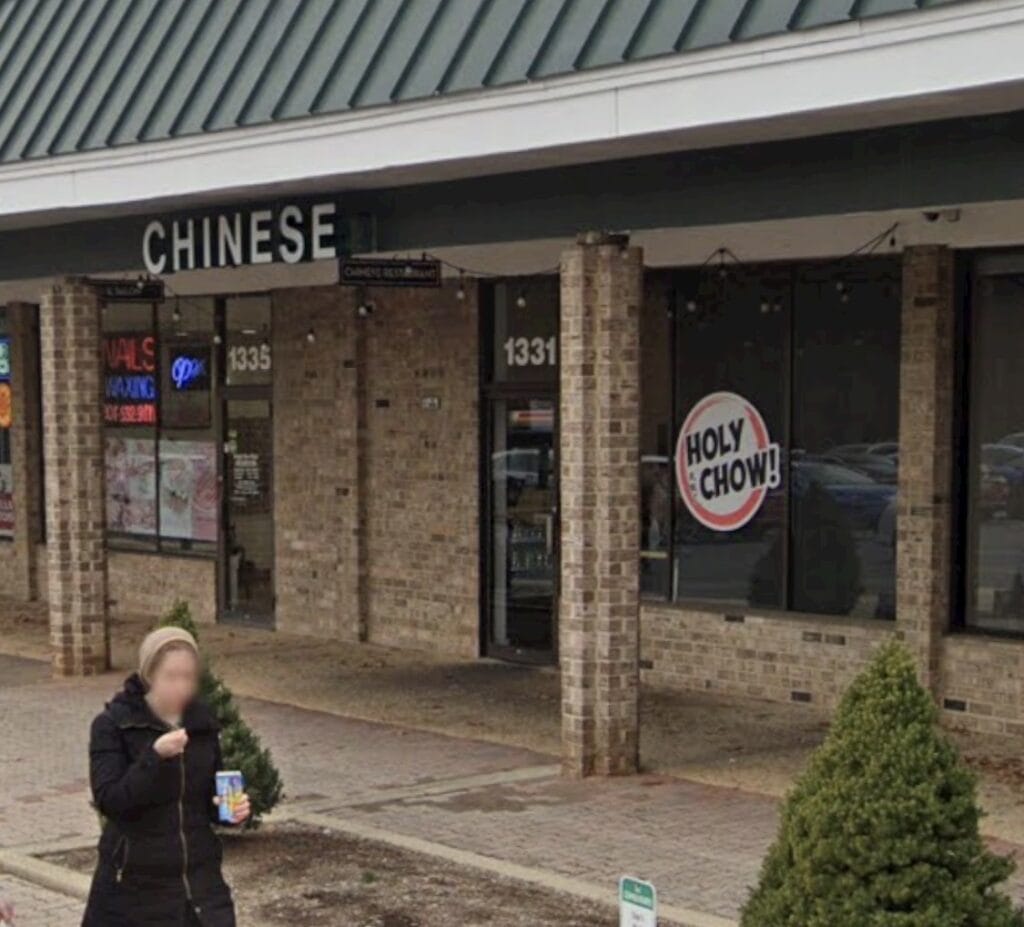
Holy Chow, a kosher Chinese restaurant at 1331 Lamberton Drive in Silver Spring, says it will permanently close this Sunday, September 20, or once its remaining inventory is sold, unless it receives immediate and sustained community support.
The owner said orders have declined 30% over the past two to three years while catering business has nearly disappeared and food, labor and other operating costs have increased.
The restaurant, which would have celebrated its 10th anniversary next year, said consistent support from customers, schools, synagogues and other community organizations is needed for the business to remain viable.
Holy Chow serves kosher Chinese dishes including egg rolls, dumplings, fried rice, soups, chicken and beef.
Full message below:
“HOLY CHOW CLOSING
Next year, Holy Chow would have been celebrating its 10th anniversary. I’ve been trying to figure out how to write this letter for weeks, and I don’t think there’s a gentle way to say it so I’m just going to cut to the chase: unless there is immediate, real support from this community starting now, we will be closing permanently this Sunday or until all inventory is sold.
This is going to be a pretty long message, so I don’t expect many people to read it through until the end. But I feel like I have one chance at this and I really want to lay all the cards out on the table.
If you read nothing else here, read this: the fastest way to help right now isn’t to place an order today; it’s to buy a gift card. A wave of one-time orders in the next 24 hours would overwhelm a kitchen of our size; a $100 gift card from anyone who knows they’ll eat here again sometime this year is what actually keeps us open. I’ll come back to that at the end, but first I want to explain why this place is worth fighting for, because that’s the part that’s hardest to put into words.This commitment can’t just be a one time thing either. It needs to be consistent and it can’t just be the same people over and over again. Making Holy Chow (and all of the other kosher restaurants) successful means real community support. I’ve always said that the strength of a Jewish community is not defined by the number of shuls or Jewish Day Schools. It is defined by the number of kosher restaurants. A truly vibrant and healthy Jewish community is the one where people from out of town go “There are a ton of kosher restaurants there!”. And I stand by that statement to this day and I’d be hard pressed to find anyone who disagrees with me.
It started with my family. All three of my boys have worked at Holy Chow. My two older sons have been the backbone of our staff for years and still work here regularly; my youngest comes in whenever he can. Watching them grow up behind that counter, learning how to handle a rush and how to treat people who walk through the door, is something I’ll never get back.
From there it grew to include our friends, and the friends our sons made along the way, and the families in this community whose kids worked alongside mine over the years. It became normal for one set of siblings to come through our kitchen a few years after the last.Then there are our regulars, the families who’ve ordered from us for years and know exactly what they want before they walk in, who’ve had us cater a bar/bat mitzvah or turned to us to get through a week of shiva. And there are the people just passing through: old friends visiting DC who make a point of stopping in, and every summer, the campers and staff who find their way to Silver Spring because there simply aren’t many kosher options like ours in this area.
For a long time, we were part of the fabric of our shuls and schools too, the caterer people called when there was a kiddush, an event, or a lunch to put together. That’s the story I wanted this restaurant to keep telling for another ten years.
Here’s the part of the story that isn’t about warmth. It’s about numbers, and I want to lay it out honestly.
Orders have dropped 30% over the last two to three years, and catering, which used to be a real piece of this business, has nearly disappeared. At the same time, food costs, labor costs, and just about every other expense have climbed sharply, and I’ve tried to absorb as much of that as I could rather than pass it on to families who are already stretched. That commitment showed up most clearly one year when I actually lowered prices the week before Passover, usually one of our busiest and most profitable weeks, because I knew the holiday itself strains people’s food budgets. In the weeks after the holiday, orders dropped 20% anyway.
Passover isn’t the only season that works against us, either. Summers are, without question, our hardest stretch, for reasons that have nothing to do with us. Schools are out, kids are away at camp, and families go on vacation. On top of that, we lose three weeks of catering entirely during the period of communal mourning, and there are the Nine Days when no one eats meat, sandwiched between two fast days that make everything even quieter. It’s a rough few months built right into the calendar, every single year.
None of that is something we can control. What we can control is the food itself and the people making it, and that’s stayed remarkably consistent. The same head chef and sous chef have been with us since the day we opened, and the recipes haven’t changed. That doesn’t mean we’ve been perfect. Restaurants have ups and downs with customer service, and we’re no exception. There’s a lot of turnover in this industry, and for many of our employees, Holy Chow was their first job, so some years the staff has been rock solid and other years a little rougher around the edges. But out of everyone who’s worked here over the years, if there were any who didn’t genuinely enjoy their time at Holy Chow, they were few and far between. Former employees have shown up during a dinner rush, hopped behind the counter, and started taking orders and answering phones like they never left, because it was second nature to them and it was fun. Most of the people who’ve moved on tell me, years later, that they miss working here. It would be a real shame if that came to an end.
There’s a quote from Maya Angelou posted on the wall by the kitchen window, right where every employee who’s ever worked here has had to see it a hundred times a shift:
“People will forget what you said. They’ll forget what you did. But they will never forget the way you made them feel.”It’s something I’ve tried to live by, and something I hope every one of them, and each of my own sons, carries with them long after they’ve left. If there’s one thing I hope Holy Chow gave the people who came through it, employees and customers alike, it’s that.
That’s part of why the consistency in the kitchen has mattered so much, because Chinese food itself is deceptively hard to get right. There are more ingredients, more combinations, and more customization than in almost any other cuisine, which means more chances for something to go wrong compared to pizza, bagels, burgers, deli etc. And because we’re takeout, we only get one shot at it. At a sit-down restaurant, a missing item gets walked out mid-meal and a dish someone doesn’t love gets remade on the spot. Peanuts, cashews, moo shu pancakes, sweet and sour sauce, rice, soup, none of that ever truly goes missing when a server can just bring it out. Chinese takeout is a lot harder to execute perfectly than most people realize, and we really do try.
None of that means I’ve been perfect, though, and I want to own my part in this directly. Over the last three years my life has changed dramatically. I’ve been struggling with the adjustment to being a single parent working a full-time job and supporting two households on only one income. Doing that alongside running a restaurant has been close to impossible some days, but I’ve kept trying. I used to be the one in the trenches with our newer employees, mentoring them, helping them build the kind of work ethic and customer service that turns a first job into something they remember for years. I haven’t been able to do that as much lately, and I take full responsibility for it. But know this: I never, ever felt like “well, we’re the only game in town so it doesn’t matter how good our food is, how high our menu prices are or how polite and competent our staff is because people will buy from us anyone because there are no other options”. If this is the message that many people have gotten over the last few years, then I need to make a much stronger effort to fix that perception. But I also want to be clear: the drop-off in orders started well before my own struggles did, especially from Jewish institutions. Long before things got hard for me personally, I was already hearing more and more often that an event had been catered by a number of different places up in Baltimore instead of by us. And while I get that people want a little variety and don’t want to eat from the same restaurants week after week, it’s important to realize that this is a one-way street. There are no people in Baltimore that order from the kosher eateries down here in the DC area the way we order from them. No one in Baltimore is organizing central point deliveries from us. So, at the end of the day, our only real revenue stream is coming from the community down here.
Whatever the reasons behind the drop-off, I never treated this business as a way to get rich. Once I made back my initial investment, I took some profit for about two years, I felt I’d earned that much. But for the last four years, even in years when there was profit to take, I’ve left every dollar in the business instead of taking any for myself, because I believed in what Holy Chow was doing for this community. For half its life, this restaurant has run less like a business and more like a service, one that has employed more people than I can count, many of whom are kids from families right here, with younger siblings following after them.I’m telling you all of this not to ask for pity, but because I think the community deserves the full picture before deciding whether this is worth saving.
And since I’m being honest, there are a few more things worth saying plainly, without bitterness, because I think they matter.
Jewish institutions in this area, schools and shuls alike, have largely stopped being part of supporting Holy Chow, even as we kept trying to be part of supporting this community. There are a number of shuls in this area that rarely order from us at all, and one or two in Kemp Mill that haven’t placed an order in years. It isn’t only institutions, either. I’ve also heard from more than one friend that some people have chosen to avoid the store over political posts I made years ago. I won’t pretend that doesn’t sting, but I understand people make their own choices about where their money goes. What’s worth remembering, though, is that I don’t take a dollar out of this business for myself, so a boycott doesn’t actually hurt me. It only hurts the community that depended on having Holy Chow here.I know eating out isn’t cheap, and I’m not asking every family to do it every week. Not everyone can afford that, and I understand it. But the bar for keeping Holy Chow open is actually pretty low. If 1,000 families across the DC area ordered from us once a month, or 12,000 families ordered just once a year, at around $100 a visit, this business would be sustainable. And it doesn’t have to be the same families every time. Kemp Mill alone has more than three times as many kosher-keeping families required to keep us chugging along, and Montgomery County has roughly 10,000 kosher-keeping Jewish families total (out of around 30,000), more than 10 times what we’d actually need, without even counting DC, Northern Virginia, or any of the other smaller communities around the Beltway.
The last three years have been the hardest of my life, financially and personally, and I won’t pretend that losing Holy Chow now wouldn’t be one more heavy loss on top of that. But at this point it isn’t really about me. It’s about whether this community wants a kosher restaurant that has been showing up for it for almost ten years to still be here next year.
If the answer is yes, I need to see it this week: in orders, in catering bookings, in institutions willing to actually stand behind a business that has quietly stood behind this community for a long time.Like I said at the start, the best way to help right now isn’t necessarily to order today. If everyone tries to order at once, we’ll be flooded and won’t be able to get through the next 24 hours. If you know you’re going to order from us at least once over the next year, buy a $100 gift card instead. It isn’t charity. It’s a commitment. Just the same thing we’ve given you for nine years: showing up.
Ami
NOTE: If we end up having to close the store customers who purchased gift cards will be notified in advance so they can use them.”
