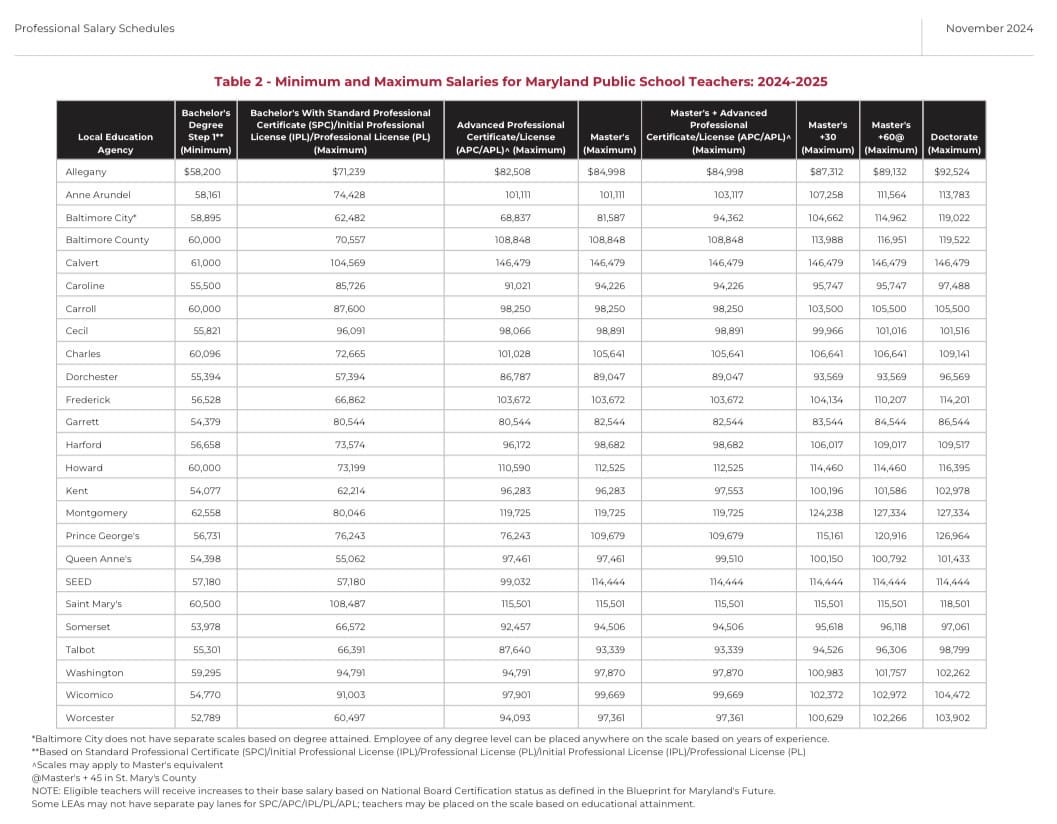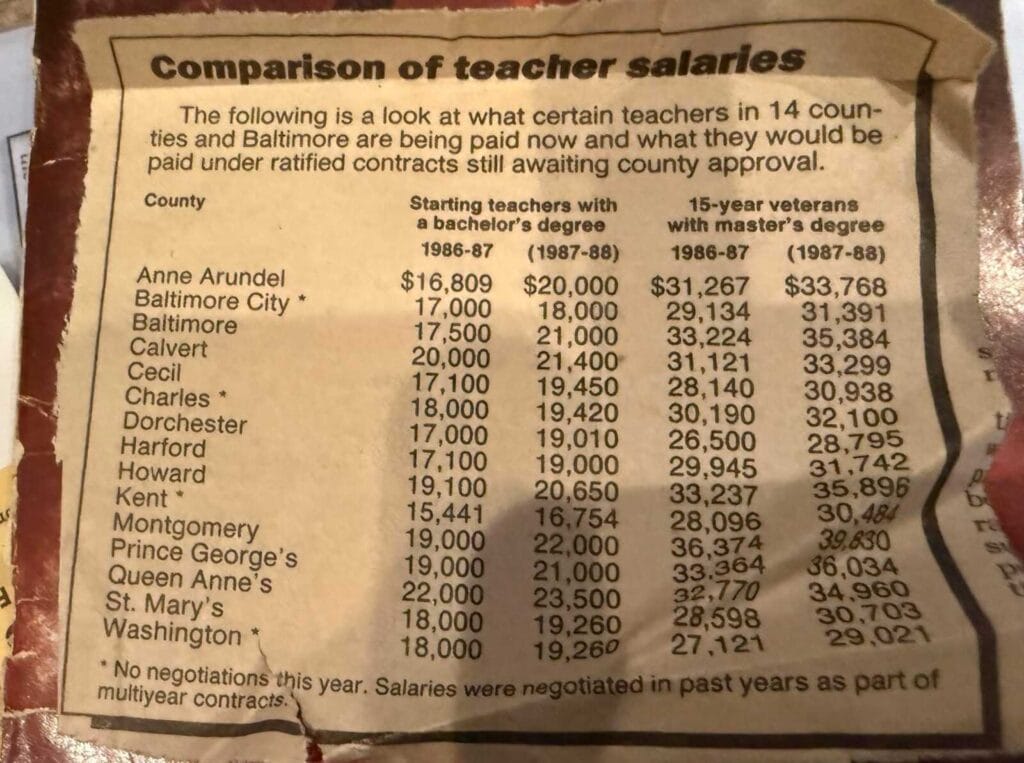
In the mid 1980s, a starting teacher in Montgomery County earned about $19,000 a year. A 15-year veteran with a master’s degree made just over $36,000. Those numbers appeared alongside similar figures from counties across Maryland, forming a routine salary comparison meant to inform readers about current pay and pending contract approvals.
At the time, the differences between jurisdictions mattered, but they were relatively narrow. Most starting salaries clustered between $16,000 and $20,000. Veteran teachers of 15 years made it to the low to mid $30,000 range. It was a landscape where teacher pay varied by county, but not dramatically.
The clipping itself comes from Trish WS, who shared that she likely cut it out of either The Baltimore Sun or The News American during the summer after she graduated from college. It was not saved as a keepsake or a piece of history, but as practical information during a moment of transition into adulthood. Decades later, the yellowed paper reads like a time capsule, capturing a period when mid teen salaries were considered normal and long-term earnings capped out at figures that now barely register as entry level.
Adjusted for inflation, a $15,000 starting salary from the mid 1980s would equal roughly $40,000 to $43,000 today. In other words, simply keeping pace with rising prices would put that old starting pay well below what new teachers currently earn.
Fast forward to the 2024-2025 school year (last year, but the latest available for all Maryland counties on the MSDE website) and the scale has changed entirely. A starting teacher with a bachelor’s degree in Montgomery County now earns just over $62,000. At the top of today’s salary schedules, experienced teachers with advanced degrees can earn well into six figures, with maximum pay in some Maryland counties exceeding $120,000 and, in Calvert County, climbing past $140,000.
What stands out most is not just the growth in salaries, but how much the spread between counties has widened. In the 1980s, teacher pay across Maryland existed within a relatively tight band. Today, starting salaries vary by more than $10,000 depending on the jurisdiction, and maximum salaries can differ by tens of thousands of dollars. Cost of living, local funding priorities, and bargaining power now play a much larger role in shaping teacher compensation.
The career arc has also changed. In the mid 1980s, a teacher with 15 years of experience and a master’s degree earned less than twice the salary of a new teacher, reflecting a relatively compressed pay structure. Today, salary schedules extend much further, with many additional steps beyond 15 years of experience. The gap between entry-level pay and the highest steps on the scale can exceed $60,000, driven by longer pay ladders, advanced certifications, and additional degree incentives that have reshaped what a full teaching career looks like financially.
Placed side by side, the two snapshots tell a broader story about how education, expectations, and economics have evolved. Teacher salaries in Maryland have risen over time, but so have living costs, credential requirements, and the day to day demands of the job. The profession has also entered an era of constant visibility, with classrooms, school systems, and education decisions now discussed and dissected in real time on social media. What was once a relatively uniform, modestly paid profession now varies more widely by region, reflecting differences in local funding, cost of living, and the growing complexity of the work itself.