

With summer coming to an end and the possibility of cooler weather in the coming weeks, two familiar publications are offering a look ahead at what winter 2026-2027 could bring to Montgomery County and the surrounding region.
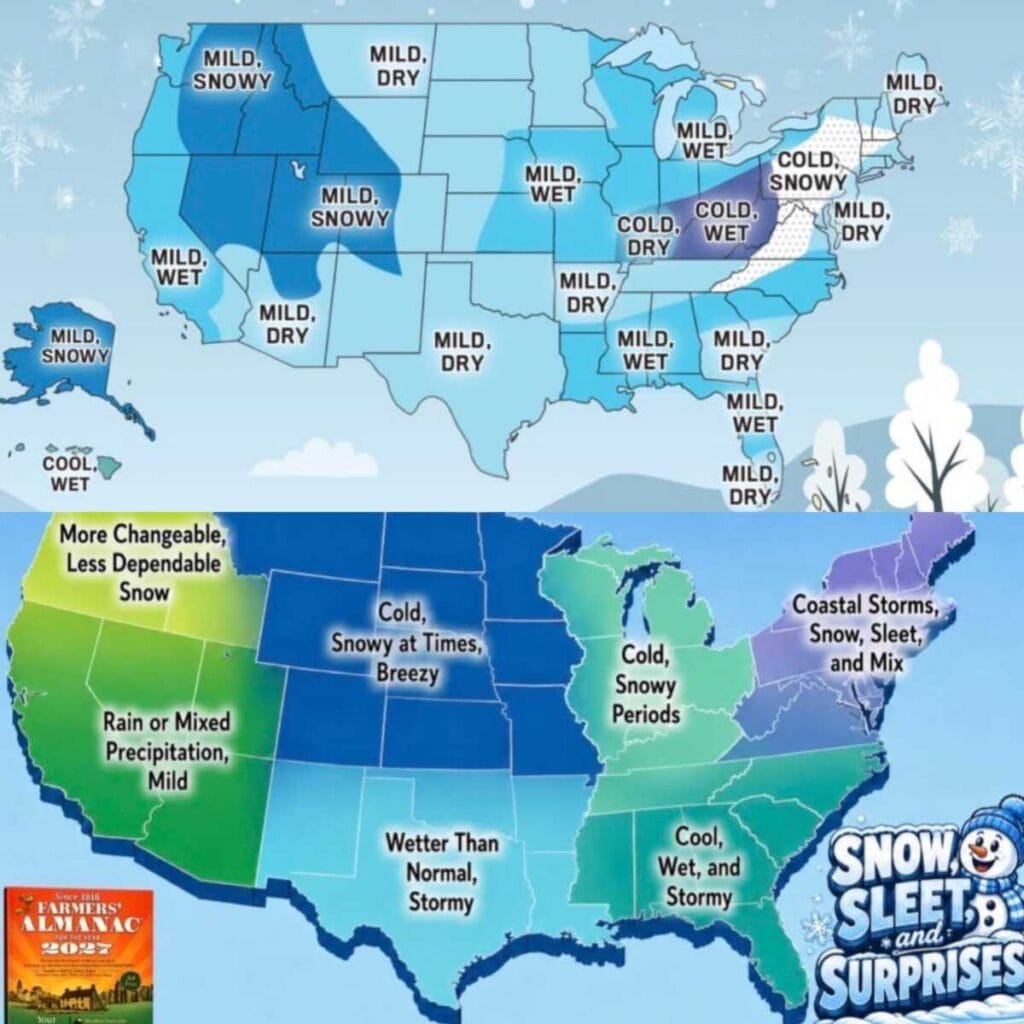
The Farmers’ Almanac places much of the Mid-Atlantic in a zone labeled “coastal storms, snow, sleet, and mix,” while The Old Farmer’s Almanac places the Washington region within a “cold, snowy” area on its national map. Despite their similar names, the publications are separate, and their outlooks offer different expectations for the season.
The Farmers’ Almanac anticipates an active winter pattern in which relatively small differences in temperatures and storm tracks could determine whether communities receive rain, snow, sleet or freezing rain. Its outlook suggests coastal areas could see more rain and mixed precipitation, while inland areas could experience several rounds of heavy, wet snow, particularly in January and February.
For Montgomery County, that outlook describes a familiar winter setup, with the potential for precipitation types to vary over short distances. It does not offer a specific snowfall total for the county.
The Old Farmer’s Almanac presents a more complicated picture. Its national map places Montgomery County, Washington, DC, and much of Maryland and Northern Virginia in a “cold, snowy” zone. However, its detailed Atlantic Corridor forecast, which includes the Washington region, calls for a milder winter overall, with above-normal temperatures, below-normal precipitation and slightly below-normal snowfall.
That distinction matters when interpreting the map. While the broad label suggests a cold and snowy season, the regional forecast offers a more restrained outlook. Cold and snowy stretches can occur during an otherwise mild winter, but the two descriptions still provide different impressions of what residents should expect.
The Old Farmer’s Almanac identifies early to mid-December, early to mid-January, and early and late February as the coldest periods. Its predicted windows for snow include late November, early and mid-January, early and late February, and late March.
Both outlooks leave room for winter weather in the region, particularly during January and February. The Farmers’ Almanac emphasizes coastal storms and a variety of precipitation types, while The Old Farmer’s Almanac pairs its “cold, snowy” map label with a regional forecast calling for slightly below-normal snowfall.
For now, the outlooks provide an early look at the publications’ expectations. They should be viewed as broad seasonal predictions rather than forecasts of specific storms, snow days or snowfall totals. A clearer picture of individual winter weather threats will come from local forecasts much closer to each potential event.
