

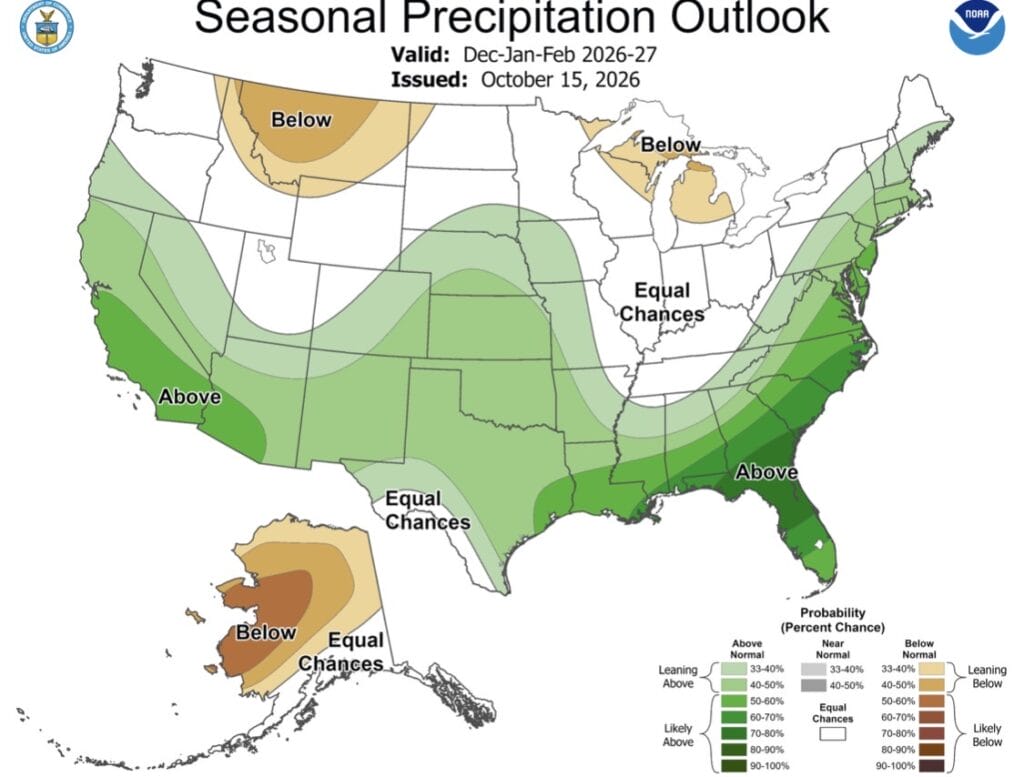
NOAA has released its U.S. Winter Outlook for the 2026-2027 season, with warmer and wetter-than-average conditions favored for the Washington D.C. region.
The outlook, released October 15, covers December 2026 through February 2027 and is heavily influenced by a very strong El Niño. According to NOAA, El Niño is expected to shift the jet stream southward and eastward across the contiguous United States, increasing the likelihood of stormier weather across the southern U.S. and along the East Coast.
For much of Maryland, D.C., and northern Virginia, NOAA’s temperature outlook favors above-average temperatures for the winter as a whole. Much of the eastern United States is included in an area where warmer-than-average seasonal temperatures are considered more likely.
At the same time, NOAA’s precipitation outlook favors wetter-than-average conditions along the East Coast, including our area. The wetter pattern extends across much of the southern tier of the country before continuing north along the coast.
“As we know from decades of observations, a very strong El Niño will likely bring a southward and eastward shift to the jet stream for the contiguous U.S., which tilts the odds toward stormier weather across the South,” said Ken Graham, director of NOAA’s National Weather Service.
While the combination of a wetter winter and a more active storm track could create opportunities for winter storms, NOAA’s seasonal outlook should not be interpreted as a prediction of an especially snowy winter.
NOAA does not forecast seasonal snowfall totals in its winter outlook, noting that snow forecasts generally cannot be made reliably more than about a week in advance. Above-average precipitation includes rain, snow, ice, and other forms of precipitation, while warmer-than-average temperatures refer to the average across the entire three-month period.
That means a warmer-than-average winter can still include stretches of cold weather and individual snow or ice storms. NOAA is also forecasting drought conditions to improve or end across parts of the East Coast through the winter.
The agency will continue updating its three-month outlook throughout the season, with the next update scheduled for November 19.
