

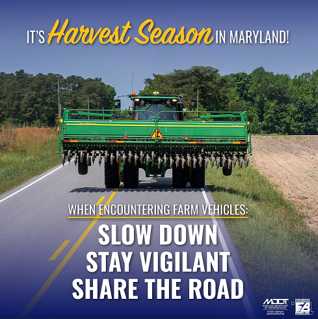
Maryland transportation and agriculture officials are urging drivers to use extra caution around farm equipment as the state’s fall harvest season continues through November.
With more than 12,000 working farms across Maryland, combines and other large, slow-moving agricultural vehicles are more likely to be traveling on state and local roads this time of year. According to the Maryland Department of Transportation State Highway Administration, more than 280 crashes involving farm equipment occurred on Maryland roads between 2020 and 2025.
Officials are asking drivers to slow down, remain alert and be patient when approaching agricultural equipment, which may travel significantly slower than normal traffic.
Drivers should use extreme caution when attempting to pass farm equipment and should not pass on turns, hills or other locations where visibility is limited. Passing is also prohibited in designated no-passing zones and within 100 feet of intersections, railroad crossings, bridges, elevated structures and tunnels.
The State Highway Administration also cautioned motorists against assuming that farm equipment moving toward the right side of the road is allowing vehicles to pass. Because of their size, some farm vehicles need to move right before making a wide left turn into a field, driveway or gate.
“The leaves are changing and days are getting shorter which tells us that Maryland’s harvest season is underway,” State Highway Administrator Will Pines said. “We want everyone to be safe during this busy time of the year and be Serious About Safety by using patience, paying close attention and giving harvest equipment the space they need to get to the fields.”
The reminder comes during an unusual harvest season in Maryland. Earlier this month, Governor Wes Moore issued an executive order declaring a state of emergency to provide temporary relief to the state’s agricultural and forestry industries amid record-high diesel fuel prices.
Maryland Secretary of Agriculture Kevin Atticks said a little patience from motorists can help protect farmers during one of their busiest times of the year.
Officials recommend allowing additional travel time during harvest season in areas where farm equipment is likely to be using the roads.
