

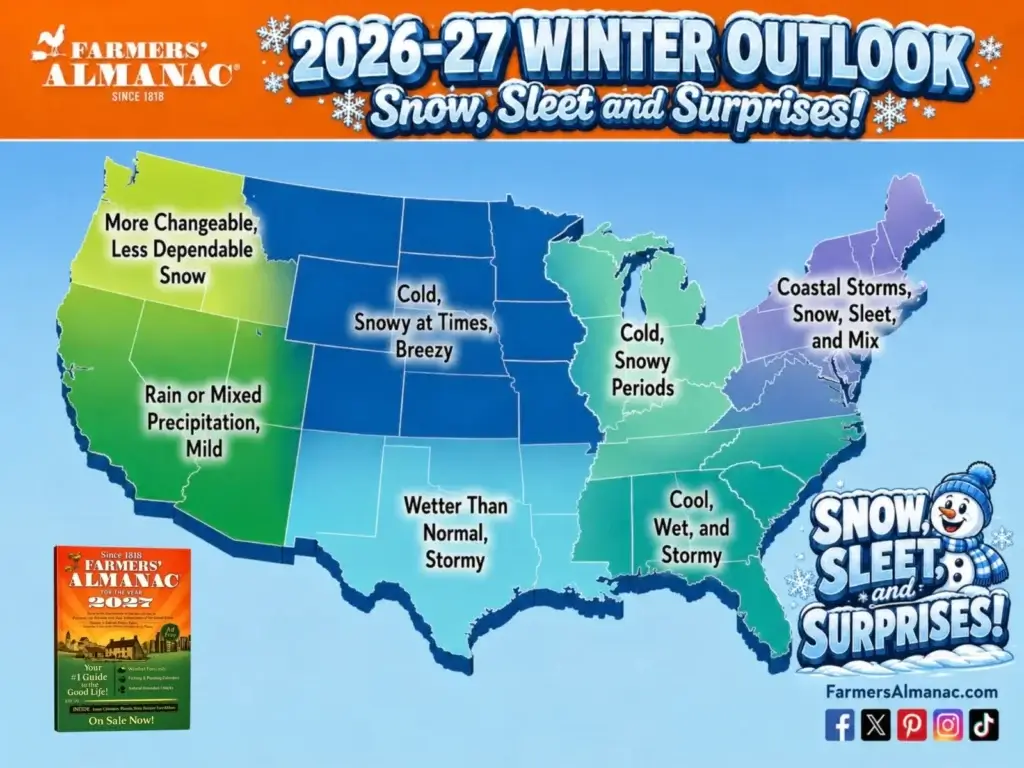
The Farmers’ Almanac has released its latest Winter Outlook for the 2026-2027 season, placing Maryland, Washington, D.C., and Virginia in a region labeled “Coastal Storms, Snow, Sleet, and Mix” on its forecast map. This is different than the latest update of the Old Farmer’s Almanac Winter OutlookOld Farmer’s Almanac Winter Outlook we recently discussed.
According to the Farmers’ Almanac, the upcoming winter is expected to feature sharp contrasts across the country, with El Niño playing an important role in weather patterns. Wetter-than-normal conditions are favored across much of the southern United States, while northern areas could experience quick cold snaps, brief snowy periods, and frequent stretches of milder weather.
For Maryland and Washington, D.C., which fall within the Almanac’s Northeast and New England forecast zone, the outlook calls for a potentially complicated winter weather pattern. A storm track along the Eastern Seaboard could bring a variety of precipitation types, with temperatures frequently hovering near freezing.
“The Northeast may face one of the season’s most complicated winter patterns,” the Farmers’ Almanac states. The outlook indicates that coastal communities could experience more rain or mixed precipitation, while inland areas, particularly higher elevations of Pennsylvania and northern New England, could see several rounds of heavy, wet snow during January and February.
For Montgomery County and the surrounding Washington, D.C. region, the forecast suggests that small changes in storm tracks and temperatures could determine whether individual systems produce rain, sleet, freezing rain, or accumulating snow.
Virginia falls within the Almanac’s Southeast forecast zone, where conditions are expected to be cool, wet, and stormy. Although snow is not expected to be the primary winter weather threat across most of the Southeast, the outlook notes that colder air interacting with moisture could produce sleet, freezing rain, or heavy, wet snow during some storms.
The Farmers’ Almanac cautions that forecasts could change quickly as individual storms approach, particularly in areas where temperatures remain close to freezing. The outlook is a seasonal prediction rather than a forecast of specific storms or snowfall totals.
