

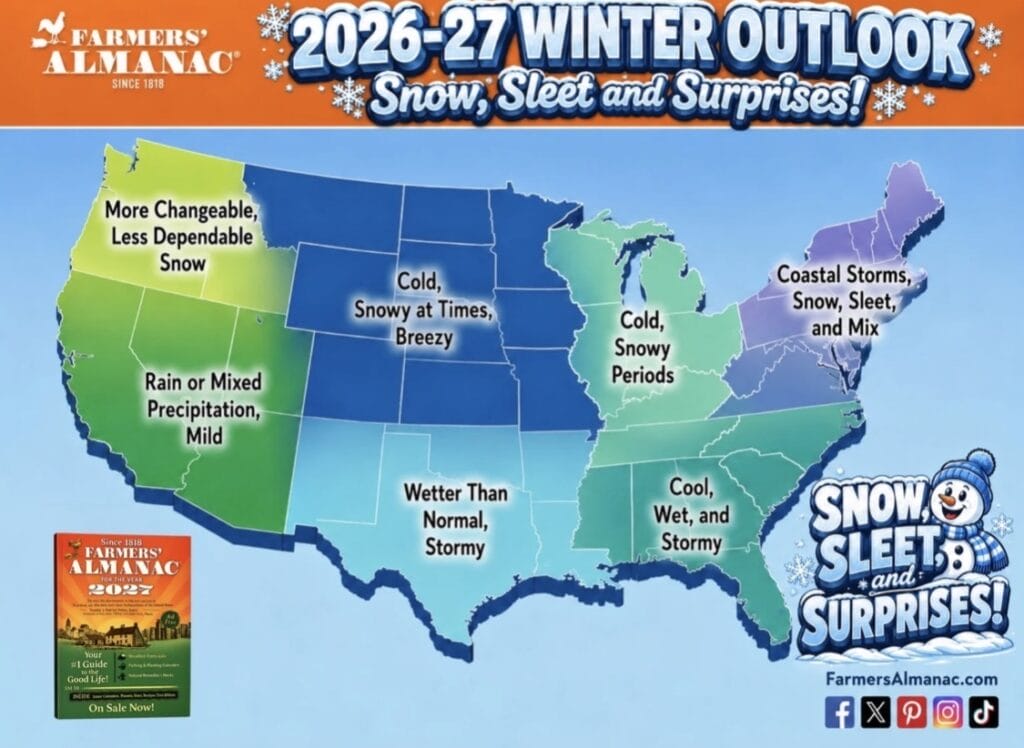
The Farmers’ Almanac has released its outlook for the 2026-2027 winter season, placing much of the Mid-Atlantic in a region expected to experience “coastal storms, snow, sleet, and mix.”
The region highlighted in the outlook includes Maryland, Washington, DC, Virginia, West Virginia, Pennsylvania, New York and several other states. According to the Farmers’ Almanac, El Niño is expected to remain an important factor through the heart of the winter season, contributing to wetter-than-normal conditions across much of the southern United States.
For the Northeast and Mid-Atlantic, the Almanac anticipates a particularly complicated winter pattern in which relatively small differences in temperatures and storm tracks could determine whether individual systems bring rain, snow, sleet or freezing rain.
“Coastal communities could receive more rain or mixed precipitation, while inland areas may be hit by several rounds of heavy, wet snow, particularly during January and February,” the Farmers’ Almanac states.
The Almanac cautions that forecasts could change quickly as individual storms approach, with the potential for significant differences in precipitation type across relatively short distances. That type of setup is familiar to residents of the Mid-Atlantic, where winter storms can frequently produce a combination of snow, sleet, freezing rain and rain across the region.
The 2026-2027 outlook was prepared by Farmers’ Almanac forecaster Caleb Weatherbee. According to the publication, its proprietary long-range forecasting formula dates back to its founding in 1818 and considers recurring natural cycles, solar activity, lunar influences and historical weather patterns.
The Farmers’ Almanac says those traditional calculations are now supplemented by modern forecasting tools, including satellite observations, computer modeling, current meteorological data, historical analogs and analysis of large-scale ocean and atmospheric patterns.
The publication reports an accuracy rate of approximately 80% to 85% for its regional outlooks. Independent assessments have generally placed the accuracy of long-range almanac forecasts below the publication’s own estimates, and forecasts issued months in advance should be viewed as broad seasonal outlooks rather than predictions of specific storms or snowfall totals.
For the Mid-Atlantic, the primary takeaway from the Farmers’ Almanac outlook is the potential for an active and variable winter, with coastal storms and a mix of precipitation possible and January and February highlighted as periods when inland portions of the region could see rounds of heavy, wet snow.
