Montgomery County Public Schools has released updated secondary grading and reporting guidance for the 2026-27 school year, outlining expectations for assignments, makeup work, reassessments, and artificial intelligence use.
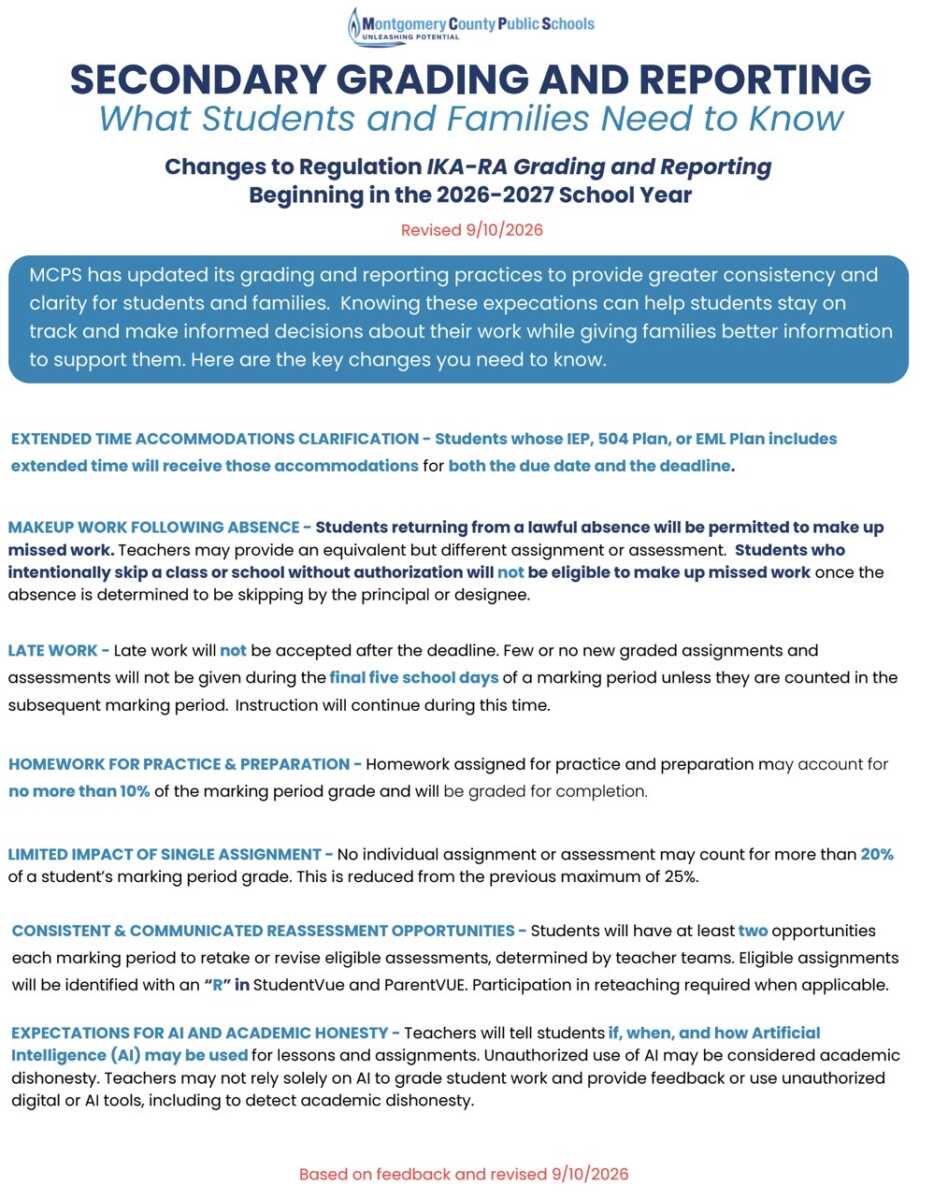
The one-page information sheet, revised September 10, explains changes to Regulation IKA-RA, Grading and Reporting. According to MCPS, the updates are intended to provide greater consistency and clearer information so students understand expectations and families can better support their academic progress.
Students whose IEP, 504 Plan, or EML Plan includes extended time will receive those accommodations for both assignment due dates and deadlines.
Students returning from a lawful absence will be permitted to make up missed work, although teachers may provide an equivalent but different assignment or assessment. Students who intentionally skip a class or school without authorization will not be eligible to make up missed work once the principal or designee determines the absence was skipping.
Late work will not be accepted after the deadline. The guidance also calls for few or no new graded assignments and assessments during the final five school days of a marking period unless they count toward the following marking period. Instruction will continue during that time.
Homework assigned for practice and preparation may account for no more than 10% of a student’s marking period grade and will be graded for completion. No individual assignment or assessment may count for more than 20% of the marking period grade, down from the previous maximum of 25%.
Students will have at least two opportunities each marking period to retake or revise eligible assessments, with eligibility determined by teacher teams. Eligible assignments will be marked with an “R” in StudentVUE and ParentVUE. Participation in reteaching will be required when applicable.
The guidance also addresses artificial intelligence and academic honesty. Teachers will explain if, when, and how students may use AI for lessons and assignments. Unauthorized use may be considered academic dishonesty.
Teachers may not rely solely on AI to grade student work and provide feedback. They also may not use unauthorized digital or AI tools, including tools used to detect academic dishonesty.