

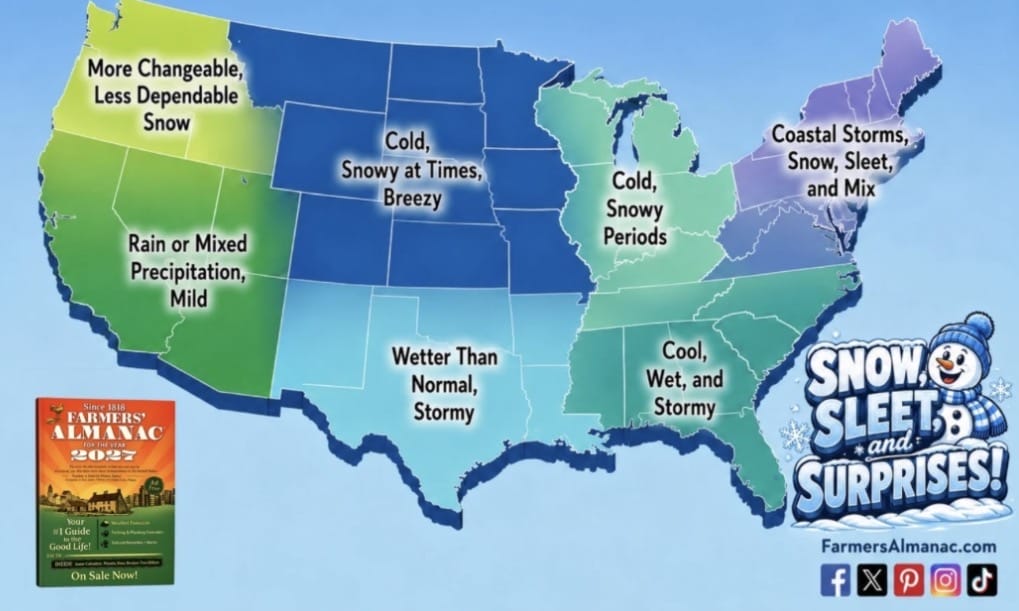
The Farmers’ Almanac has provided an October update for its 2026-2027 winter weather outlook, and Maryland could be in for an unpredictable season featuring snow, rain, sleet and freezing rain. Maryland and the northeast remain in the region labeled “coastal storms, snow, sleet, and mix.”
The updated forecast, released this month, calls for “A Tricky Winter For The Northeast,” a region that includes Maryland, Washington, D.C., Connecticut, Delaware, Maine, Massachusetts, New Hampshire, New Jersey, New York, Pennsylvania, Rhode Island and Vermont.
According to the Farmers’ Almanac, the Northeast could experience one of the more complicated weather patterns of the upcoming winter. Coastal areas are expected to see more rain and mixed precipitation, while inland locations could receive several rounds of heavy, wet snow, particularly during January and February.
The Almanac says temperatures frequently hovering near the freezing mark could make precipitation type especially difficult to predict. Relatively small changes in temperatures or storm tracks could determine whether an approaching system produces rain, sleet, freezing rain or accumulating snow.
That uncertainty could be particularly relevant for Maryland and the D.C. area, which often sits near the dividing line between warmer coastal air and colder air to the north and west during winter storms.
The Farmers’ Almanac is also forecasting an active southern storm track that could produce heavier-than-normal precipitation from California and the Southwest through Texas, the Gulf Coast and Southeast. A second storm path could carry systems along the Eastern Seaboard, creating additional opportunities for rain, wintry mixes and snow from the Mid-Atlantic through New England.
“A slight change in temperature or storm direction could turn a cold rain into an icy mix – or transform a slushy snowfall into a significant winter storm,” according to the outlook.
The Farmers’ Almanac says its 2026-2027 outlook was prepared by forecaster Caleb Weatherbee using the publication’s proprietary forecasting formula, which dates to its founding in 1818. The method considers natural cycles, solar activity, lunar influences and historical weather patterns, according to the publication, while incorporating modern forecasting tools such as satellite observations, computer modeling, current meteorological data and analysis of larger ocean and atmospheric patterns.
Overall, the Farmers’ Almanac expects winter 2026-2027 to be characterized by contrasting conditions across the country, including an active and wet southern storm track, bursts of snow and cold across northern areas and an especially unpredictable mix of precipitation in the Northeast.
The publication reports an accuracy rate of approximately 80% to 85% for its regional outlooks. Independent assessments have generally placed the accuracy of long-range almanac forecasts below the publication’s own estimates, and forecasts issued months in advance should be viewed as broad seasonal outlooks rather than predictions of specific storms or snowfall totals.
