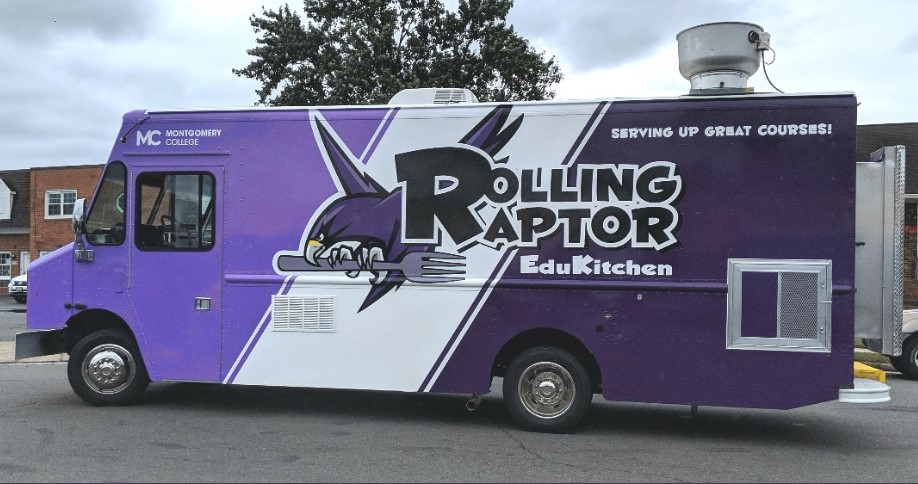
Per Montgomery College: The Rolling Raptor EduKitchen is a 26-foot-long mobile food lab that arrived at Montgomery College in October. It is equipped with the most cutting-edge culinary equipment and technology to serve as a business lab that facilitates experiential learning experiences for students within the Hospitality Management Program. Its design enables students to develop a food truck business/ concept, fabricate and test out products to be served, cost out and develop menus, operate the food truck in a real setting (e.g., golf courses, breweries, City of Rockville events), and finally evaluate the success of the concept based on customer feedback and financial gains or losses. 

“The Rolling Raptor creates an unprecedented opportunity for students to gain real-life entrepreneurial experiences throughout their studies at Montgomery College,” said Jana Anderson, Hospitality Management Program coordinator and associate professor at Montgomery College. “The mobile food lab allows students to bring the products and business ventures they develop in the classroom to actual customers in real-life settings. It also creates an opportunity for the Hospitality Management Program to partner with local businesses such as True Respite Brewing Company in securing locations for the Rolling Raptor.”
Per MCPS: Due to a  recent change in a Maryland law, students will not be charged to participate in dual-enrollment programs. Montgomery College will refund students who have paid tuition for college courses taken this fall. Students taking college courses during the remainder of this school year will not be charged tuition, but may be responsible for other college costs, such as textbooks or fees. Beginning in the 2023-2024 school year, all eligible students may take approved college courses at no cost. FAQ Below:


“Together we can change society in the ways that matter most: reducing poverty, increasing economic and social mobility, and producing students who are ambitious and deeply engaged in society,” President Williams said, delivering his inaugural address. “As we prepare students for post completion success, we need mentors and local business leaders to meet us there—to amplify the impact we already have. As we bring more innovation and technology into our classrooms, we need direction from small business owners, industry leaders, and economists about what kinds of job skills are needed.”

Greetings were provided by elected officials Christopher Van Hollen Jr. U.S. Senator, Maryland, Jamin B. “Jamie” Raskin U.S. Representative, Maryland’s 8th Congressional District, Benjamin F. Kramer Maryland State Senator, District 19, Marc B. Elrich Montgomery County Executive, Gabriel I. Albornoz President, Montgomery County Council.


Recently approved Blueprint for Maryland’s Future legislation expands full-day pre-K access so that all children are ready to learn and excel in kindergarten. As a result, MSDE has created a mixed-delivery system of public and private early childhood programs to support families and their young children. A mixed delivery system requires that approved PreK Expansion programs in child care-based centers be staffed with a state-certified teacher compensated with an entry salary that matches the local school system. While many community-based programs employ child care teachers with bachelor’s degrees and several years of preschool teaching experience, these child care teachers are not state teacher certified. MC’s new certification program will address the certification requirement for MSDE’s expanded mixed delivery system for early childhood education programs.

MSDE grant funding will allow the alternative certification program to be provided at no cost to qualifying program participants pursuing certification. The target audience for the MC Early Childhood Alternative Certification Program is early childhood educators with bachelor’s degrees working in approved nonpublic nursery schools or selected candidates that meet qualifications from the local school system. Completers of the MC ECACP will be certified as pre-K to third grade teachers in the state of Maryland.


Dr. Williams’ work in higher education has focused his energies on improving access for students, as well as retention, graduation, and post-completion success. He has paid special attention to mitigating institutional, societal, and racial inequities, strategically creating programs and policies that support historically underrepresented and/or marginalized groups. He has years of experience designing, managing, and enhancing institutional and statewide programs and initiatives that have yielded positive student outcomes.

The inaugural ceremony on October 19 will include:


The committee consists of two members appointed by the County Executive, one by the Montgomery College Alumni Association and two by the County Council. The current Council representatives on the committee are Kenneth Jones and Althea Lloyd-White. The terms are for two years.  The Nominating Committee was established by state law and has no limit to the number of terms members can serve.

The committee reviews applications for vacancies on the Board of Trustees of Montgomery College and submits recommendations to the Governor, who makes the appointment.  Approximately three committee meetings are held each year. Meeting dates and locations are arranged at the convenience of the entire committee. In the past, the committee chairperson has requested that committee members also attend several Board of Trustees meetings.


In August we let you know of a joint-venture between Minkoff Development and South Duvall signing a lease with Hughes Network Systems, LLC (HUGHES) to build a 140,000 square foot build-to-suit project on Montgomery College’s Germantown Campus. The Hughes Network Systems Sattelite Production Facility broke ground on Monday and will be bringing approximately 300 jobs to Germantown, according to Gaithersburg-Germantown Chamber of Commerce CEO, Marilyn Balcombe.

The campus currently is home to the Pinkney Innovation Complex for Science and Technology at Montgomery College (PIC MC) with Holy Cross Germantown Hospital as its anchor tenant. Located at 19710 Observation Drive in Germantown, Maryland, adjacent to the Hughes headquarters complex (11717 Exploration Lane), the new high-tech manufacturing building will house production of Hughes satellite broadband and networking equipment.


The Pullias Center for Higher Education at the University of Southern California’s Rossier School of Education, in partnership with the American Association of Colleges & Universities (AAC&U) has selected Montgomery College as one of two winners of the Delphi Award for 2022. The other winner is Dominican University (CA). Montgomery College and Dominican will each receive $15,000 cash awards to continue their work to support adjunct, contingent, and/or non-tenure-track faculty (NTTF) in promoting student success.

“From a competitive pool of applicants, we chose this year’s winners for their significant work ensuring that contingent faculty are supported,” stated Professor Adrianna Kezar, Director of the Pullias Center and primary investigator on the Delphi Project. “The two organizations selected have instituted scalable and innovative institutional policies that remove equity barriers for non-tenure-track faculty and are prime examples of the exemplary work occurring across the country.”


The Montgomery College (MC) Tech Metro Area Pathways (TechMAP) Program, which aims to serve 1,000 students over a four-year funding period, will be fully funded by the SSC2 grant to provide career pathways training in Information Technology (IT). The MC TechMAP Program will improve the retention, completion, and employment rates of individuals historically underrepresented in IT, including people of color, women, and disconnected youth/young adults. Additionally, individuals who are un- or underemployed, including as a result of COVID-19-related layoffs, will be invited to apply to upskill and/or reskill. To this end, the MC TechMAP Program will increase personalized navigation to help students understand their career options, enroll in a program of study and connect to the wrap around supports needed to stay on track for completion. The navigators will move with students as they progress from non-credit to for-credit degrees or as they lattice together various credentials.

The system of navigation is designed to be scalable to other programs or other community colleges and to interface with the workforce system and employers to help participants find on-the-job training and careers. TechMAP is expected to increase retention and completion rates for underrepresented students, leading to higher numbers of participants who earn professional credentials and who find quality work with higher wages. MC will partner with workforce development system partners, employer partners, and social resource partners to support the educational, employment, and wraparound service needs of participants.


With Americans struggling financially due to rising inflation and a year of community college nearly three times less expensive than a year at a public four-year college, the personal-finance website WalletHub today released its report on 2022’s Best & Worst Community Colleges, coupled with its state-by-state ranking of the Best & Worst Community-College Systems, Montgomery College was ranked 7th out of over 650 community colleges, coming it at 19th in the ‘Career Outcomes’ category, while Maryland was ranked 2nd in “States With the Best Community College System.”

Per the article: “Other than serving as an affordable, and in some cases free, option for education, community colleges have a number of attractive qualities. They often provide more flexible schedules, smaller class sizes and rigorous coursework. Some even go beyond two-year programs to offer four-year bachelor’s degrees. These qualities advantages appeal especially to students who need to balance their studies with other commitments, such as family and work.


View More Stories