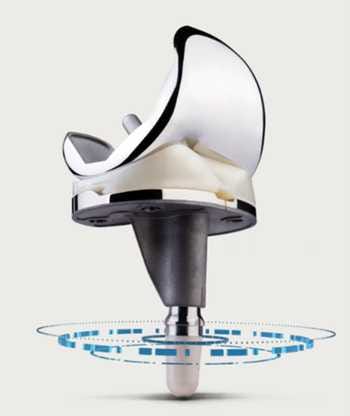
MedStar Montgomery Medical Center is now among the first hospitals in Maryland to perform total knee replacement procedures using the Persona IQ “smart knee,” an advanced implant equipped with a secure motion-tracking sensor designed to help patients and doctors better understand recovery during the first year after surgery.
The innovative implant, also being used at MedStar Union Memorial Hospital, features a sensor built into the stem extension of the knee joint. Made from biocompatible materials and identical in size to a standard implant stem, the sensor measures key aspects of knee function such as step count, stride length, cadence, walking speed, and range of motion. Each night, when patients sleep within six feet of a small bedside transponder, the device wirelessly uploads the data to a secure software system. The technology does not track patient location, and its battery lasts for at least ten years, after which the implant continues to function normally without transmitting data.
One of the first patients to receive the smart implant was a 66-year-old Frederick woman named Mary, who underwent surgery at MedStar Union Memorial under the care of Dr. Mark Hasenauer. She chose the implant after suffering a severe knee injury and exhausting non-surgical options. “I consider myself an early adopter,” she said. “I liked the idea that the doctor was able to monitor my motion data and give me real time feedback.” When her step count dropped during recovery due to tendonitis, the data allowed her doctor to reassure her that her progress remained on track.
Dr. Hasenauer, who has now performed nearly a dozen smart knee procedures, said the goal is to enhance, not replace, clinical assessments. “Every patient heals differently. Persona IQ can help keep patients engaged and allow us to track patterns in mobility between visits, taking age and the healing time into consideration.”
At MedStar Montgomery, Dr. Katharine Harper recently completed the hospital’s first smart knee procedure on a 72-year-old man who returned home the same day. She noted that the growing database of patient motion data could significantly advance orthopedic research. Patients may opt into a national program that collects anonymized information from across the country. “Billions of motion data points are being collected,” Dr. Harper said. “Persona IQ can provide gait curves from a patient’s everyday movement, offering insights that once required a full laboratory analysis. These curves may allow us to identify underlying issues earlier than if we wait for them to present clinically.”
With the rollout of Persona IQ at both MedStar Montgomery and MedStar Union Memorial, MedStar Health joins a small but growing number of hospital systems contributing to the next generation of orthopedic innovation. “Our mission is to deliver care that is both innovative and deeply personal,” Dr. Hasenauer said. “Smart implants allow us to better understand how patients recover in real life, not just in the exam room.”