

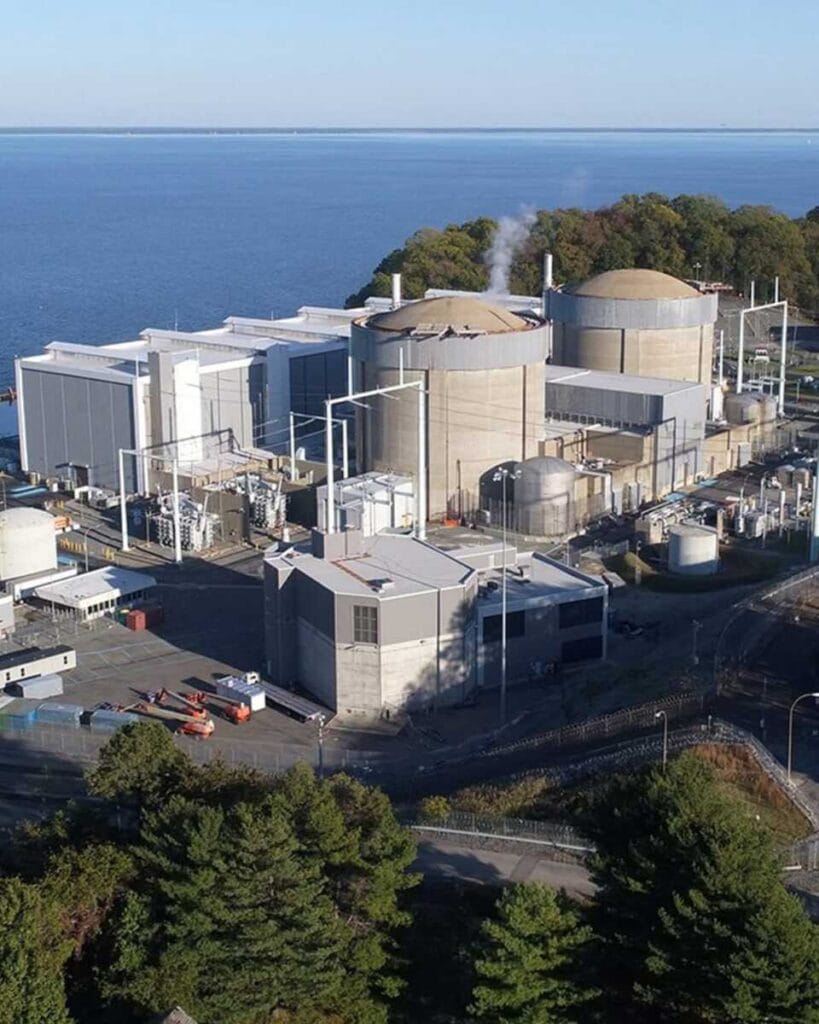
Maryland’s only nuclear power plant, the Calvert Cliffs Clean Energy Center in Lusby, continues to play an outsized role in powering the state nearly 50 years after first coming online.
Earlier this week, the U.S. Department of Energy highlighted the facility’s national significance, noting that Calvert Cliffs provides nearly 40% of Maryland’s electricity and helped pave the way for many of the reactors operating across the United States today. The recognition coincided with an anniversary for Unit 2, which first connected to the grid during this week back in 1976, one year after Unit 1 began operations.
Owned and operated by Constellation Energy, Calvert Cliffs houses two nuclear reactors that together produce up to 1,790 megawatts of clean, carbon-free electricity, enough to power the equivalent of more than 1.3 million homes. Beyond its role in the grid, the site sits on scenic land overlooking the Chesapeake Bay and is home to a Champion Chestnut Oak listed in the American Forests national register, a reminder that major energy infrastructure and environmental stewardship coexist at the facility.
Calvert County’s Division of Emergency Management oversees preparedness planning around the plant, which has been part of the Lusby community since 1975. The plant provides hundreds of well-paying local jobs and contributes approximately $22.8 million in annual tax revenue to support schools, infrastructure, and community services. Nuclear facilities in the United States are initially licensed to operate for 40 years, with the option of 20-year renewals. The Nuclear Regulatory Commission granted Calvert Cliffs its first renewal on March 23, 2000, authorizing Unit 1 to operate through 2034 and Unit 2 through 2036. Constellation notes that safety remains its most important obligation, and nuclear plants are among the most heavily protected private-sector facilities in the country, monitored through continuous inspections by operators, local officials, and federal regulators.
Maryland also maintains a clear public-safety plan in the unlikely event of an emergency at Calvert Cliffs. Sirens installed throughout the region would alert anyone within a 10-mile radius, sounding a steady three- to five-minute signal instructing residents to tune into an Emergency Alert System station. Officials would then broadcast step-by-step instructions, which could include staying indoors with doors and windows closed, turning off fans or air conditioners that draw outside air, or taking potassium iodide pills, but only if directed by state or county authorities. If evacuation becomes necessary, residents would follow designated routes to established reception centers.
For nearly half a century, Calvert Cliffs has been one of Maryland’s most dependable energy sources and a major contributor to the state economy. With renewed interest in nuclear power’s role in a clean-energy future, the Lusby facility remains a critical piece of Maryland’s infrastructure and one of the region’s most influential power-producing sites.
