

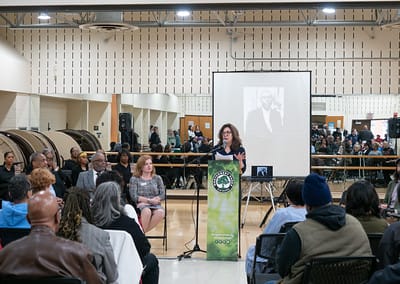
Montgomery Parks and community members gathered Sunday to celebrate new interpretive signs honoring the history of Emory Grove, an African American community in Gaithersburg founded by formerly enslaved people in 1864. Nearly 100 residents and descendants of Emory Grove attended the March 1, 2026 gathering at Johnson’s Local Park, where the new signs were unveiled. The bilingual signs, presented in English and Spanish, highlight the stories of the people who built the community and describe daily life, religious gatherings, and the generations who lived there. An audio post installed at the park also allows visitors to hear first-person accounts and reflections tied to Emory Grove’s history.
Montgomery Parks Director Miti Figueredo said the project ensures the stories shared by local families will remain accessible for future generations. “Montgomery Parks is honored to join the Emory Grove community to help preserve and share this important history,” Figueredo said. “Families trusted us with their memories, and these interpretive signs ensure that their stories will be accessible to the broader community for generations to come.”
Johnson’s Local Park sits at the center of the historic Emory Grove community and is named for businessman Edward Johnson, who purchased the land in 1947 and developed it into an entertainment hub for African Americans. The property featured a dance pavilion and a premier baseball field with lights, hosting local Black sandlot games as well as appearances by prominent African American baseball players from the late 1940s through the 1960s. Johnson later sold the land to Montgomery County in 1970. The Maryland-National Capital Park and Planning Commission eventually acquired the property, and the public park opened in 1974.
Carolyn Taylor, a fourth-generation Emory Grove descendant, said the park and church remain the most visible links to the historic community. “Emory Grove is a place that lives in the heart,” Taylor said. “There are no original houses left. There is the church, and there’s the park. Those of us who are still here love each other and extend our love to all of you, hoping that you will come to Johnson’s Park.”
State Delegate Gregory Wims also reflected on the role Emory Grove played in the broader African American community in Montgomery County. “I grew up in a nearby African American community,” Wims said. “We didn’t have a dentist, doctor, grocery store or a big park, so my family would come to Emory Grove every week. Emory Grove shaped my life and my family’s life. It is important that people recognize Emory Grove’s significance to African American history in this region.”
Councilmember Dawn Luedtke said the park served as a central gathering place for generations before urban renewal changed the area. “For generations before urban renewal, Johnson’s Local Park served as a gathering place for families, the setting for church events and camp meetings, and a famed baseball venue for local Black sandlot and Negro League teams,” Luedtke said. “Our entire community owes everyone who participated in this project gratitude for sharing their stories.”
The new interpretive displays are part of Montgomery Parks’ Untold Stories program, which highlights important historical narratives connected to county parkland.
