

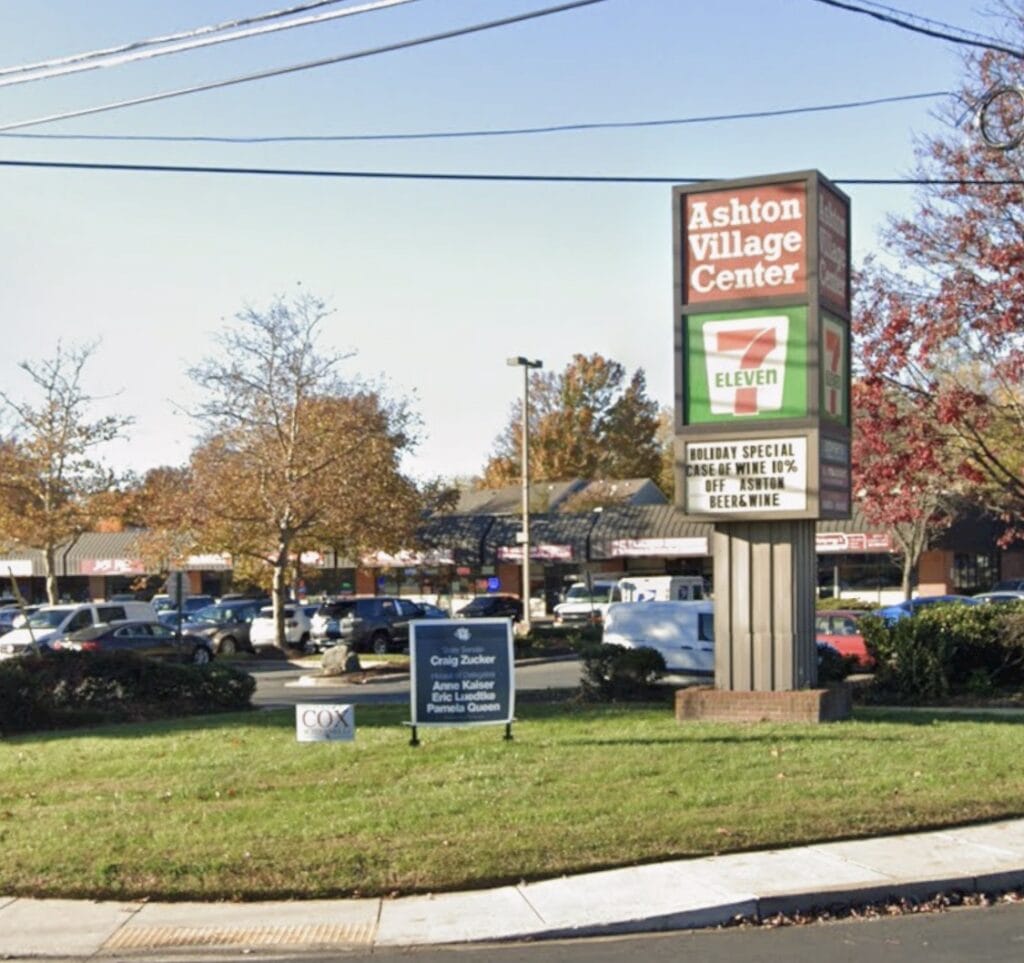
Construction on what is now known as Ashton Village Shopping Center got underway in April 1965, following its announcement in a March 18, 1965 edition of the Gaithersburg Gazette.
At the time, the project was introduced as the Ashton Shopping Center and described as an “ultra-modern” retail concept, reflecting the evolving approach to suburban shopping in Montgomery County during the mid-1960s. Plans called for a design focused on both convenience and comfort, including enclosed walkways that would allow shoppers to move between stores while being shielded from sudden temperature changes. Based on the outcome, it doesn’t appear those walkways came to fruition.
The center was slated for the northwest corner of the Ashton crossroads and was designed with colonial architectural elements, blending traditional aesthetics with what was then considered cutting-edge retail functionality. The concept highlighted a shift away from purely open-air shopping layouts toward more controlled, shopper-friendly environments.
As Montgomery County’s population continued to grow during that era, developments like the Ashton Shopping Center were seen as key pieces of infrastructure, bringing retail and services closer to expanding suburban communities.
More than six decades later, the now-named Ashton Village Shopping Center remains a steady presence in Ashton. Today, it is home to longtime local favorites like Dempsey’s and El Andariego, businesses that reflect the center’s continued role as a neighborhood gathering place.
Per the Gaithersburg Gazette in 1965:
“Gov, J. Millard Tawes and a host of state officials plan to be on hand April 30 for the groundbreaking ceremonies for the Ashton Shopping Center.
The new center is planned by Wilbur N. Baughman and Roy Hunt; is believed to be first in the east with enclosed air conditioned and beated sidewalks. The design calls for all walks leading from store to store in the area to be glass-enclosed, to “prevent that sudden change of temperature” particularly when stepping into the summer heat from an air-conditioned building.
The center, to be located on the northwest corner of the Ashton crossroad, will follow colonial lines in design.”
