


The Montgomery County Council reached a preliminary agreement on the County’s $7.9 billion FY27 operating budget and $6.3 billion six-year Capital Improvements Program, with much of the debate centered around taxes and government spending.
Councilmembers rejected County Executive Marc Elrich’s proposed 6.1% property tax increase and instead approved a new progressive income tax structure that officials say will reduce taxes for about 95% of residents compared to the Executive’s original proposal.
Under the new plan, residents will pay lower income taxes on the first $150,000 of earned income, while households making more than $150,000 will pay the higher 3.3% income tax rate originally proposed by the Executive. According to the Council, households earning up to $50,000 could receive up to a $250 tax break, while those earning between $50,001 and $150,000 could see up to $450 in relief compared to the Executive’s proposal. Council leaders said the goal was to provide targeted tax relief while avoiding a broad property tax increase during a period of rising living costs.
In response, Elrich defended his original proposal, arguing that additional revenue was necessary to maintain County services and long-term financial stability. He criticized the Council’s approach as regressive, saying the elimination of the Income Tax Offset Credit effectively shifts more of the tax burden onto homeowners while leaving commercial property owners unaffected. Elrich also warned that the Council relied on “gimmicks and one-time maneuvers” to close budget gaps and said the adopted framework does not do enough to support schools, vulnerable residents, and future County needs.
The Council also emphasized efforts to slow spending growth, reducing the proposed increase in government spending from 5.7% to 4.4% while maintaining reserve funding needed to preserve the County’s triple-A bond rating. Officials said budget reductions across departments were used to help offset tax burdens while still funding major priorities such as schools, public safety, transportation, affordable housing, climate initiatives, and health and human services.
Per Montgomery County: “Today the Montgomery County Council reached agreement on the County’s $7.9 billion Fiscal Year (FY) 2027 Operating Budget, the $1.3 billion FY27 Capital Budget and the $6.3 billion FY27-32 Capital Improvements Program (CIP). The Council implemented a progressive income tax structure, proposed by Council President Natali Fani-González and amended by the Government Operations and Fiscal Policy Committee and Council Vice President Marilyn Balcombe, which provides tax relief to more residents in a more equitable way than the County Executive’s proposed across-the-board 3.3% income tax increase. As a result, 95% of residents will see income tax savings compared to this year. The Council also rejected the County Executive’s proposed 6.1% property tax increase.
“The Montgomery County Council’s budget decisions this year have been some of the most challenging since the Great Recession. I want to express my appreciation to Vice President Marilyn Balcombe and each of my Council colleagues for the way we worked through each decision to produce the capital and operating budget. I also want to thank all of our residents, community partners and nonprofit organizations who expressed their views on the budget throughout our deliberations,” said Council President Fani-González.
“Based on my budget plan, this Council dug deep into the data, peeled back layers of budget assumptions, and made sure every dollar in this more than $7.9 billion operating budget is going toward its highest and best use. Current economic conditions faced each day by so many working families and residents called for us to disrupt the status quo, propose innovative budget strategies and compromise on many budget reductions across departments and agencies.
“There were three key decisions that shaped this budget. First, we rejected the County Executive’s 6.1 percent proposed property tax increase. Next, we instituted a new progressive income tax structure where 95% of residents will receive an income tax break, while the highest earners will be asked to pay slightly more. Finally, we made cuts to proposed government spending because every dollar saved helped to reduce the tax burden on our community members.
“Just like food, childcare and utility expenses, the cost of doing business and providing baseline County services continues to climb. We understand that families, small businesses and nonprofit organizations across our wonderfully diverse County are operating in an ever-evolving fiscal reality where cruel and unpredictable changes made by the federal administration are requiring us all to step up and do more with less.”
Council President Fani-González’s full budget statement can be found here.
A final Council vote on the FY27 Operating and Capital Budgets and the FY27-32 CIP is scheduled for Thursday, May 21. The budgets will go into effect on July 1.
The Council reached a preliminary agreement on the operating budget with a vote of 9 to 2. Council President Natali Fani-González, Council Vice President Balcombe, and Councilmembers Shebra Evans, Evan Glass, Will Jawando, Sidney Katz, Kristin Mink, Laurie-Anne Sayles and Kate Stewart voted to support the agreement on the operating budget. Councilmembers Andrew Friedson and Dawn Luedtke voted against the agreement on the operating budget.
The Council reached a preliminary agreement on the capital budget with a vote of 9 to 2. Council President Natali Fani-González, Council Vice President Balcombe, and Councilmembers Shebra Evans, Evan Glass, Will Jawando, Sidney Katz, Kristin Mink, Laurie-Anne Sayles and Kate Stewart voted to support the agreement on the FY27 Capital Budget and six-year CIP. Councilmembers Andrew Friedson and Dawn Luedtke voted against the agreement on the FY27 Capital Budget and the six-year CIP.
New Progressive Income Tax Structure and Holding the Line on the Property Tax Rate
The Council agreed to implement a new progressive income tax structure, proposed by Council President Natali Fani-González and amended by the Government Operations and Fiscal Policy Committee and Council Vice President Marilyn Balcombe, that will result in every Montgomery County resident paying less income tax on the first $150,000 of earned income. The Council rejected the County Executive’s across-the-board proposed income tax rate increase from 3.2% to 3.3% regardless of income.
Under the new income tax structure, households reporting up to and including $50,000 will receive up to a $250 tax break when compared with the County Executive’s proposal; those earning a $50,001 to $150,000 will get up to a $450 tax break; and those earning more than $150,000 will be subject to the 3.3% income tax rate.
Additionally, the Council rejected the County Executive’s proposed property tax increase of 6.3 cents per $100 of assessed property value. Property taxes are one of the most significant annual expenses for homeowners. Raising the property tax rate would have increased the cost of homeownership for residents who are already paying more for insurance premiums, utilities and other expenses.
The Council’s progressive tax structure will result in additional tax relief for those who need it most. For example, a renter earning $50,000 would have paid $50 more under the County Executive’s budget proposal, instead of receiving $250 in tax relief under the Council’s agreement. A homeowner earning $150,000 with a $645,000 home and no Income Tax Offset Credit (ITOC) will see a $450 tax break, as compared to paying $506 more under the Executive’s plan. Additional tax scenarios are found in the tax structure comparison chart.
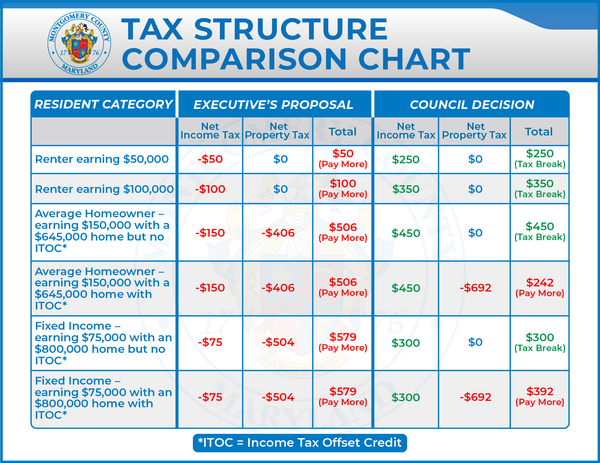
Many property tax credits remain available to eligible County homeowners including the County Homestead Tax Credit, Individuals 65 and Above and Retired Military Services Members Tax Credit, the Senior Property Tax Credit and the State Homeowners Property Tax Credit.
Reserve Funding and the Structural Deficit
Maintaining reserve funding is necessary for the County to keep its highly coveted triple-A bond rating and to deal with unforeseen emergencies. The Council’s budget maintains the reserves at the same level as recommended by the Executive.
This budget also slows the growth in government spending proposed by the County Executive from 5.7% to 4.4% by making strategic investments in critical services for residents, while achieving savings in other funding categories.
Education
For more than a decade, the Montgomery County Council has funded Montgomery County Public Schools (MCPS) beyond the state mandated Maintenance of Effort (MOE) level in the amount of nearly $956 million from FY17 to FY27. This year, the Council voted to fund MCPS at more than $3.7 billion, which is $143.7 million more than last year and $156.6 million above MOE, which is the required level of per pupil funding that must be maintained by counties in Maryland year-over-year. As part of this funding, MCPS will receive $25 million from the pre-funding of the retiree health benefit trust. This use of funds will assist MCPS in meeting its payments for retiree benefits, address cash flow issues, and make other funds available to MCPS to address needs as it takes action to address escalating health care costs.
As the largest school system in Maryland focused on academic excellence for more than 156,000 students across 211 schools, MCPS will receive approximately 47 percent of the County’s operating budget.
The operating budget also provides $351 million for Montgomery College in support of higher education and economic and workforce development. Montgomery College serves more than 50,000 students each year and removes financial barriers to continuing education while supporting student success.
Early care and early childhood education is a top priority for the Council and more than $39.5 million is allocated for these programs. High-quality, early childhood education services promote lifelong learning, school readiness and social skills. Investing in these services also helps to close the achievement gap, leads to higher graduation rates and produces better health and economic outcomes.
The Council also approved $56 million in funding for Montgomery County Public Libraries to continue their mission of providing equitable access to information, ideas and experiences in library branches across the County.
Investments in all forms of education, including programs offered by multiple departments and community partners, create positive impacts for economic development and a significant return on investment for students, taxpayers and our community.
Public Safety
Montgomery County’s first responders and funding for public safety are essential to preserving the peace, safety and welfare of our community and protecting the rights of all residents. Operating budget allocations for public safety services are approximately 10 percent of the budget. The Council provided $384 million in funding for the Montgomery County Police Department, $310 million for the Fire and Rescue Service, and $33 million for the Sheriff’s Office.
The Office of Animal Services received $11.5 million to continue to provide sheltering and care to homeless, abused and neglected animals in our community and ensure the safety and welfare of residents. This includes funding to support the addition of two new animal care attendant positions, who will enhance the Animal Services and Adoption Center’s ability to provide care for animals in the center.
The Office of Emergency Management and Homeland Security received more than $7 million in funding to coordinate and implement emergency planning and response. Additionally, $1.2 million was provided for Nonprofit Security Grants to help nonprofit and religious groups that need enhanced security related to hate crimes and public safety threats.
Safety Net Services
The Department of Health and Human Services (DHHS) is the second largest budget component. A total of $574 million has been allocated to the critical services DHHS provides, such as its public health services, minority health initiatives and programs, aging and disability services, social services office and more. The DHHS budget includes nearly $68.2 million for Services to End and Prevent Homelessness, including investments in supportive housing, rapid rehousing, housing stability services and healthcare services for residents experiencing homelessness. The budget also significantly expands the Behavioral Health and Crisis Services to more than $98 million, including support for the County’s 24-Hour Crisis Center, school-based mental health services, trauma services and prevention and harm reduction programs.
Montgomery County relies on community partners and nonprofit organizations to serve our most vulnerable residents. Faced with ever-increasing demands and ongoing cost increases driven by federal cuts the Council is providing a 3.5% inflationary increase for nonprofit service providers. This inflationary increase is needed to help service providers continue their critical services for as many residents as possible.
The Council also maintained the Working Families Income Supplement. This tax credit aims to help reduce the tax burden on working families with low-to-moderate incomes. This funding matches 56% of the Maryland Earned Income Tax Credit (EITC) and is automatically provided to residents who qualify for the state EITC.
Housing
The Council allocated $77.5 million for the Department of Housing and Community Affairs to continue supporting the County’s efforts to preserve and expand affordable housing, enforce housing and property standards and administer rent stabilization and landlord-tenant programs.
Additionally, the Council included $52.3 million in the Housing Initiative Fund, which serves as the County’s primary affordable housing funding source. The fund supports rental assistance programs, Housing First initiatives to help residents experiencing homelessness secure permanent housing, first-time homebuyer assistance and other projects to preserve and expand affordable housing opportunities throughout the County.
The Council also provided more than $9.5 million for the Housing Opportunities Commission (HOC), which is the County’s public housing authority that administers various federal and state programs such as Housing Choice Vouchers. The Commission is also authorized to acquire, own, lease and operate housing; provide for the construction or renovation of housing; obtain financial assistance from any public or private source to assist its housing activities; and arrange for social services, resident services and daycare.
Quality of Life
Recreation and parks promote physical and mental health as well as social interactions and a sense of community. The Council provided funding in the amount of $70.9 million for Montgomery Recreation and $154.5 million for Montgomery Parks.
The Council approved total tax-supported funding of more than $201.6 million for the Maryland-National Capital Park and Planning Commission, which is a bi-county agency that makes recommendations on planning and growth, protects natural, cultural and historic resources, and provides leisure and recreational experiences. The Montgomery Planning Department prepares master and sector plans for Planning Board review and Council review and approval.
Arts and culture play an important role in strengthening Montgomery County’s communities and quality of life. The Council approved $6.8 million in funding for the Arts and Humanities Council to continue its work supporting excellence in arts and humanities.
Montgomery County employees are a key part of making our County a world-class community to live, work, play and raise a family. The Council voted on resolutions to approve the collective bargaining agreements and associated salary increases for all Montgomery County employees. These hardworking employees provide critical and essential services such as public safety, health and human services, recreational opportunities, transportation options and so much more that residents rely on every day.
Environment and Transportation
The Council approved $36 million in funding for the Department of Environmental Protection’s General Fund and Water Quality Protection Fund. This includes funding to support the County’s Climate Action Plan and resources for stormwater management, watershed restoration and more.
Additionally, the budget includes $16.3 million for the Montgomery County Green Bank which is a nonprofit organization dedicated to helping businesses and residents affordably implement energy efficiency and clean energy solutions.
The Council also fully funded the County Executive’s Climate Change Planning Non-Departmental Account (NDA) at nearly $450,000, which provides coordination and financial support for climate-related initiatives across County departments.
The Council also deferred a decision on the County Executive’s recommendation to send the County’s solid waste to out-of-county landfills, while there are still so many risks and unanswered questions including the cost to taxpayers, the effect on revenue, as well as impacts on the environment. Instead, the Council provided sufficient funding in the DEP Recycling and Resource Management budget to continue ongoing operations at the County’s Resource Recovery Facility during FY27. The Council looks forward to a complete, rigorous and balanced analysis of all options for trash disposal and a deep and equitable community engagement process before a final decision is made on this once-in-a-generation decision.
The Council approved more than $317.2 million in funding for the Department of Transportation, which supports services such as infrastructure maintenance and traffic management as well as the County’s free Ride On bus service. Continued funding is also included for the Vision Zero initiative, which is focused on enhancing pedestrian and bicyclist safety and eliminating traffic deaths and serious injuries on County roadways.
Economic and Workforce Development
The Council continues to support strategic investments to spur economic development. The Council approved more than $5.2 million for the Montgomery County Economic Development Corporation, which implements the County’s economic development strategic plan, including marketing, business attraction and retention, entrepreneurship and promoting the County’s economic base. Additionally, the Council provided more than $8 million for the Economic Development Fund, more than $2 million for the Small Business Support Services NDA and more than $2 million for the Incubator Programs NDA.
The Council also provided more than $3.5 million in funding for WorkSource Montgomery, which is the County’s fiscal agent responsible for local administration of the Workforce Innovation and Opportunity Act (WIOA) and coordination of the public workforce development system in Montgomery County. WorkSource Montgomery implements the federal WIOA programming and provides local workforce development services.
Capital Budget
Montgomery County’s six-year Capital Improvements Program (CIP) provides a framework for planning and financing long-term major construction projects that enhance our community. This year, the Council approved a $1.3 billion FY27 Capital Budget and a $6.3 billion six-year FY27-32 CIP to modernize schools, improve transportation, strengthen public infrastructure and more. The CIP reflects the County’s ongoing commitment to address critical school and community priorities and continued commitment to fiscal stewardship.
Montgomery County Public Schools will receive more than $1.9 billion provided over the six-year period for capital projects and $357.1 million in FY27. These projects are focused on the modernization and expansion of MCPS facilities to address aging infrastructure and improve teaching and learning environments. Some highlights for FY27 include maintaining the construction schedule for Damascus High School and Eastern Middle School and fully funding school security systems.
Additionally, $8 million in additional one-time funding is provided from eliminating the ITOC to be used for critical heating, cooling, ventilation and school security projects across the County.
Transportation projects total more than $2.2 billion over the six-year period and $385 million in FY27 to improve pedestrian and bicycle connectivity and safety, roadway conditions and transit accessibility. Some key projects include the new Burnt Hill Road Bridge as well as increases to various road maintenance and resurfacing projects.
The Council funded about $74 million in Health and Human Services capital projects to meet growing community needs for essential services. Among them, a $6.9 million appropriation to the Affordable Living Quarters project in Rockville. The site will host 18 deeply affordable, furnished and private units for one or two person households. The Council also approved $25.4 million in capital funding for the Diversion Center project to provide crisis stabilization, referral and follow-up services to adult residents, while reducing the burden on hospital emergency rooms, first responders and the criminal justice system.
The Council also prioritized major capital investments in public safety infrastructure supporting the Police Department, the Fire and Rescue Service and the Department of Correction and Rehabilitation. Key investments include $157 million for Fire and Rescue projects, $105 million for Correction and Rehabilitation facilities, and $53.9 million for Police projects, including $40 million for the new District 4 Police Station. The budget also provides $10.7 million for the County Radio Life Cycle Replacement project to help ensure reliable communication systems for first responders across the County.
County projects related to community investment total approximately $1.4 billion. Some highlights include the $21.7 million in capital funding for the Western County Recreation Center, $50 million for the Institute for Health Computing project, and $9.9 million for the ongoing North Bethesda Metro Station Area Redevelopment Infrastructure project. The FY27 capital budget also includes funding to start construction of the North Bethesda Fire Station and the Wheaton Arts and Cultural Center.
Taken together, the operating and capital budgets provide essential investments to meet the needs of more than one million residents in alignment with the County’s strategic priorities.”
