

This year marks the 60th anniversary of Montgomery Village, one of Montgomery County’s most recognizable planned communities and home to more than 40,000 residents today.
What is now a sprawling community of neighborhoods, lakes, parks, schools, shopping centers, and recreation facilities began with the vision of one man… Clarence Kettler.
In 1952, Clarence Kettler joined with his brothers, Milton and Charles, to form Kettler Brothers, Incorporated. A decade later, Clarence began pursuing an ambitious idea to create a “new town” in Montgomery County, a carefully planned community where residents could live, shop, attend school, and enjoy recreation without leaving the area.
The concept was part of a broader post-World War II movement toward planned communities, similar to places such as Reston, Virginia, and Columbia, Maryland. Looking west of Washington, D.C., Kettler saw an opportunity among the farms surrounding Gaithersburg.
In 1962, the Kettler Brothers purchased the 412-acre Walker Farm, the first and largest piece of land that would become Montgomery Village. Over time, they assembled more than 1,500 acres through the acquisition of several local farms, including the Thomas Farm, Brothers Mills, French Farm, Patton Farm, Fulks Farm, Wilson Farm, and the James Walter Deppa property.
Many of those names still live on throughout the community today. Walkers Choice, Patton Ridge, Watkins Mill, Frenchton Place, and other neighborhoods and roads serve as reminders of the area’s agricultural roots.
Construction officially began on February 28, 1966, when the Kettler Brothers broke ground for the first home. Because the land had been largely farmland, the developers wanted the new community to look established from day one. Rather than planting small saplings, they imported and planted approximately 10,000 mature pin oak trees throughout neighborhoods such as Whetstone and Stedwick. At the time, the specialized equipment used to transplant full-grown trees was among the first of its kind on the East Coast.
The Montgomery Village Foundation was established later that same year. On October 17, 1966, its Articles of Incorporation were officially filed with a mission to promote the health, safety, and welfare of Village residents. Today, the foundation continues to operate much like a local government, overseeing community amenities, recreation programs, and more than 335 acres of land.
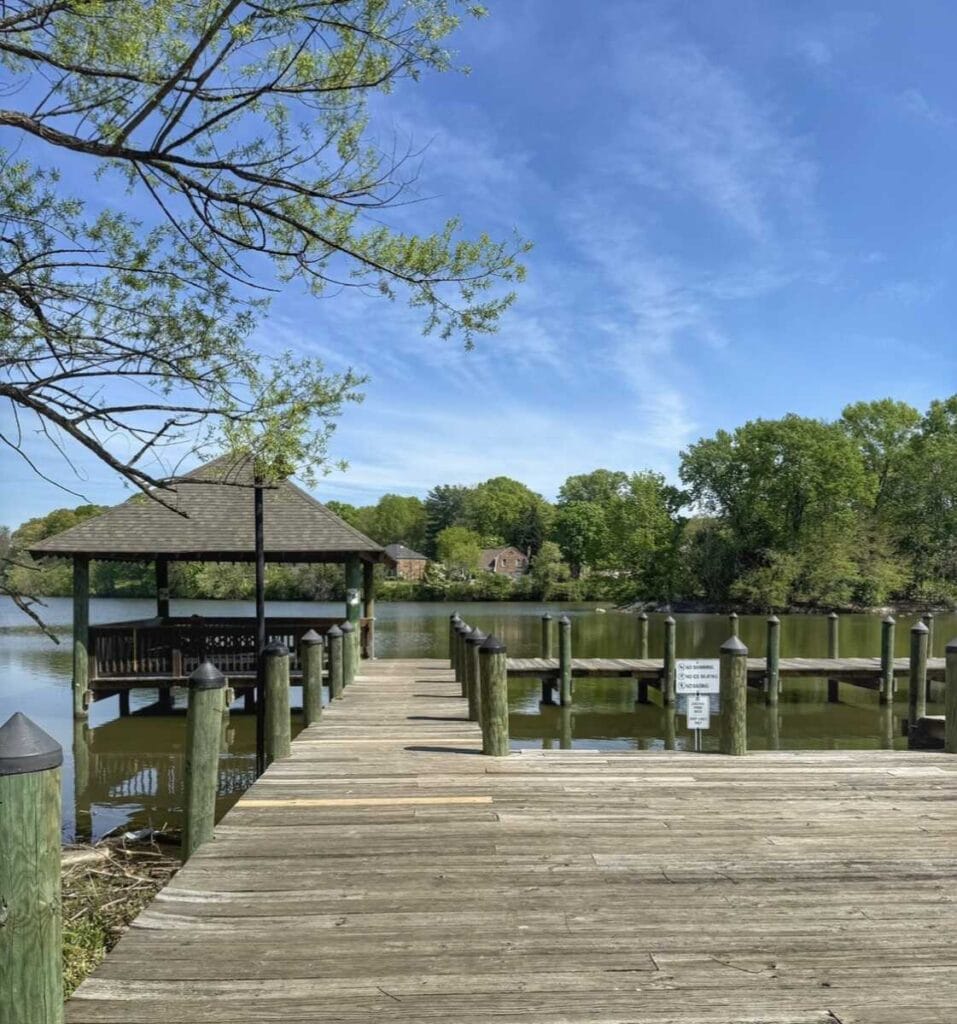
One of Montgomery Village’s defining features, Lake Whetstone, did not exist naturally. The lake was created through the construction of a dam, and its island was formed by excavating portions of the lakebed before it was filled with water. Clarence Kettler was reportedly so particular about the final appearance that he ordered the lake drained twice to make adjustments before reopening it.
Lake Whetstone opened for boating and fishing in September 1967 and quickly became one of the community’s signature landmarks. Kettler even elevated the southbound lanes of Montgomery Village Avenue to ensure drivers could enjoy views of the lake while traveling through the community.
The first residents arrived on September 25, 1967. The Bartik family moved into Goshenside, while the Crosby family moved into a home on Whetstone Drive the same day. According to Montgomery Village Foundation history, the community’s water system was not yet fully operational, requiring a water tank truck to remain at the Crosby family’s home for about a week.
As the Village continued to grow, schools, recreation facilities, and businesses followed. Whetstone Community Center, Whetstone Elementary School, and Montgomery Village Junior High School opened in 1968. The Village Mall, now known as the Village Shopping Center, opened in 1970 and was originally designed as a fully enclosed shopping mall. A Holiday Inn followed in 1971, and commuter bus service to Washington, D.C., began in 1973.
Montgomery Village was also notable for its housing diversity. At a time when most suburban developments focused on single-family homes, the Kettlers incorporated apartments, condominiums, townhomes, and detached homes into the community. The development even helped pioneer the “back-to-back townhome” concept as an affordable homeownership option.
Today, Montgomery Village spans dozens of neighborhoods connected by lakes, trails, parks, recreation centers, shopping districts, and schools. The Montgomery Village Foundation operates six pools, more than 20 sports courts, four community centers, 19 recreation and park areas, a natural amphitheater, and more.
