

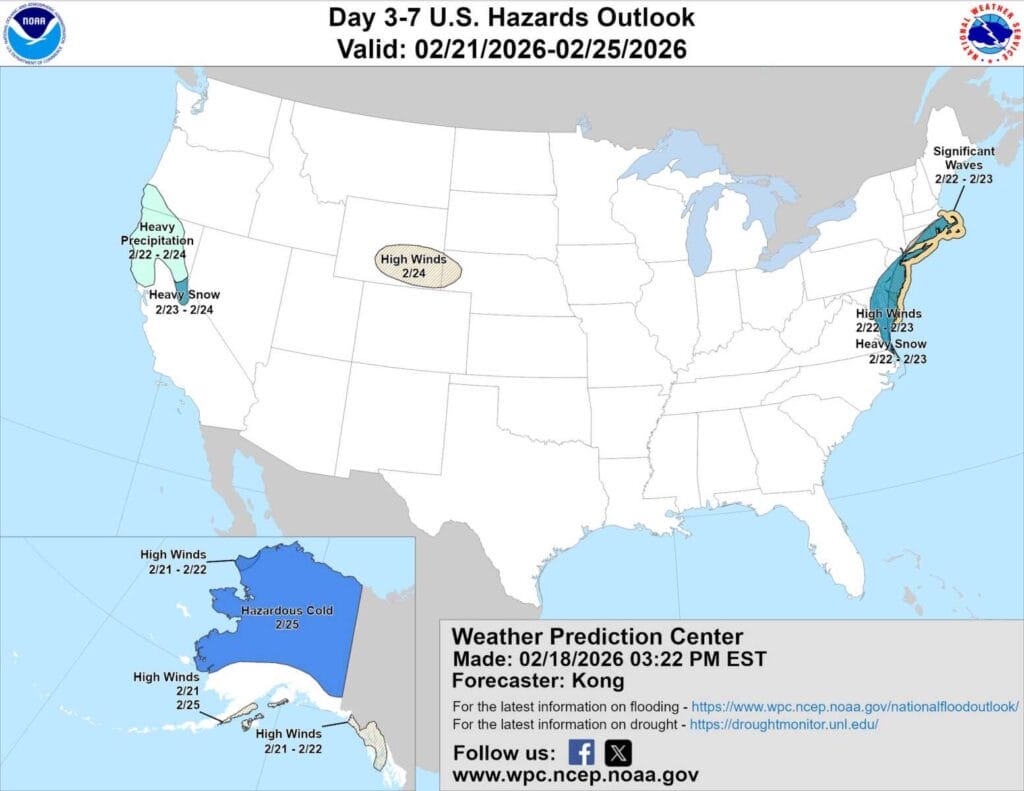
The National Weather Service Weather Prediction Center (WPC) released an updated hazards outlook placing parts of Maryland just east of our immediate area within a “Heavy Snow” risk zone as forecasters continue to monitor a potential winter storm for Sunday into Monday.
According to the WPC, model guidance remains generally aligned on the overall setup, but there is still significant uncertainty in the details. The primary focus is an intensifying low pressure system expected to develop off the Mid-Atlantic coast late Sunday into Monday. Forecast confidence remains low due to wide variability in the projected track of the storm, which will ultimately determine how far west any heavier snow may reach.
Forecasters note that the European model has consistently favored a more southern and offshore solution. Overnight guidance briefly trended that way as well, before newer runs shifted the system slightly north again. These back and forth changes are tied to how the southern and northern jet stream systems interact, which could result in a more amplified trough over the eastern United States if phasing occurs just right.
FOX5 meteorologist Mike Thomas added that the WPC Heavy Snow Threat map did not change much overall, but did expand farther south to include the Virginia Beach area. Ensemble data shows increasing confidence that at least some snowflakes will fall in the Washington region, with both European and American ensembles now above a 90 percent chance of seeing snow.
The odds of a disruptive snowfall of 2 inches or more for the DC area have also increased to just above 50 percent, up from earlier outlooks. What has decreased, however, is the chance of a major storm. Current ensemble guidance suggests roughly a 10 percent chance of 8 inches or more.
As of now, the setup supports continued monitoring rather than firm expectations. Small changes in the storm track could still have outsized impacts across the region, and forecast confidence is expected to improve as the system draws closer.
