

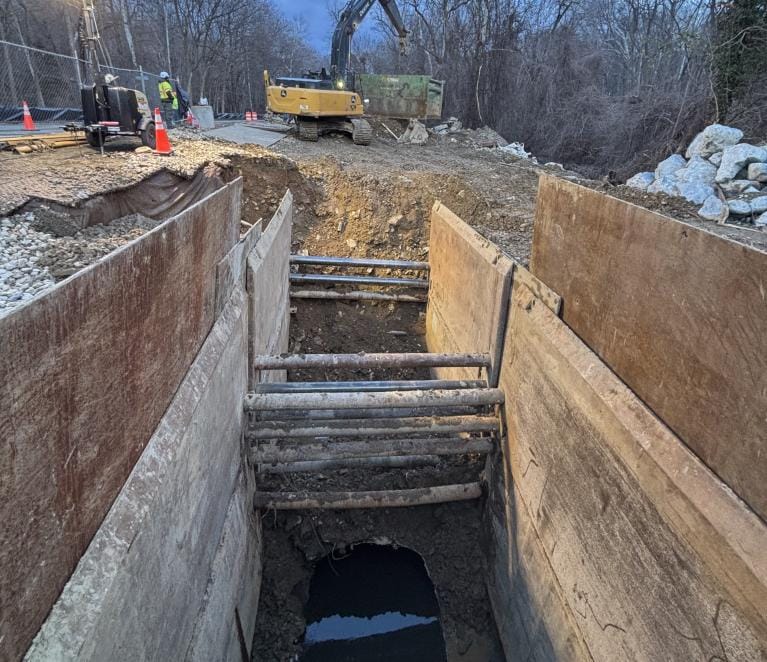
DC Water provided an update on February 23, outlining expanded repair and cleanup efforts at the site of the Potomac Interceptor that collapsed on January 19 along Clara Barton Parkway near I-495 and the C&O Canal. The collapse released an estimated 243.5 million gallons of wastewater and was described by the University of Maryland as one of the largest sewage spills in U.S. history.
According to DC Water, crews have enlarged the excavation area and installed trench boxes to stabilize the site, allowing access to a downstream section of pipe believed to be blocked by rocks and debris. Because the damaged area is too unstable for interior work, crews plan to remove part of the pipe’s upper section to safely clear the obstruction. DC Water continues to coordinate with the U.S. Army Corps of Engineers on stormwater management, while upstream and downstream cleaning efforts remain ongoing. At the same time, agencies including the Environmental Protection Agency, National Park Service, Maryland Department of the Environment, and District Department of Energy and Environment are working with DC Water on an environmental restoration plan.
DC Water is also conducting daily water quality sampling in the Potomac and Anacostia rivers and emphasized that E. coli levels naturally fluctuate due to weather, runoff, river flow, and other pollution sources. Officials said that measurements taken farther downstream cannot be attributed solely to this incident. Historical data shows E. coli levels in the Potomac can range widely, from very low readings to several thousand units on a given day. As part of mitigation efforts, DC Water is working with federal partners to divert runoff and install catchment basins to prevent contaminated water from reaching the river. Sampling results from February 16 through 22, 2026, have been posted online, and updates on repair efforts are available through DC Water’s Potomac Interceptor response page.

