

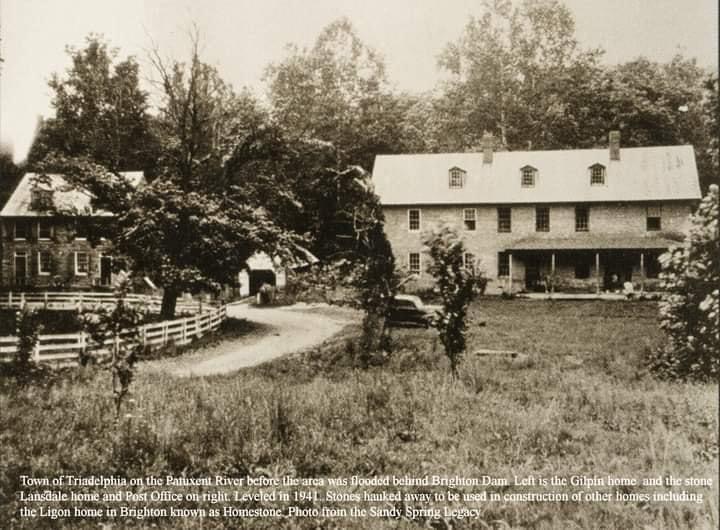
Triadelphia (“three brothers”) was founded in 1809 by brothers-in-law Thomas Moore, Isaac Briggs, and Caleb Bentley, who were married to the Brooke sisters (Descendents of Robert Brooke, the founder of Brookeville).
“Born of the Patuxent River and then destroyed by it, the mill town Triadelphia knew years of glory as a leading Maryland industrial center.” – Sandy Spring Museum. Today the Patuxent River marks the NE border of MoCo, but between 1809 and the civil war it powered the mills that made Triadelphia a thriving industrial community. At the time, it was even larger nearby Rockville.
As planned; cotton, grist, saw, and plaster mills in the town were all powered by the river. It was the only town of its kind in Montgomery County, but nearby cities, like Ellicott City, were formed with the same purpose. So what happened to Triadelphia?
The same water that helped create the thriving town ended up destroying it. A flood in 1868 causes significant damage to Triadelphia and other surrounding areas. Almost every mill was completely destroyed except for the grist mill. Entire homes were even swept away.
There were attempts to rebuild some of the other mills, but the Johnstown flood of 1889 completely destroyed everything that was rebuilt. At that point, steam power and gasoline had become far more popular. Railroads were used for transporting goods, so it was beneficial to build towns closer to the tracks, and the decision was made not to rebuild Triadelphia.
In 1943, WSSC completed construction of the Brighton Dam. This led to the complete submerging of what was left of the town. Not much remains of Triadelphia, but a graveyard that’s located on a hill overlooking the town did go untouched and a bell from 1837 that once called the mill hands in to begin work for the day can be found at Sherwood High School.
Featured photo courtesy of the Sandy Spring Legacy