With Western states running out of water, could it happen here? “Drinking Water in the DC Area: Past, Present and Future” will be the focus of a Montgomery History online presentation on Tuesday, Nov. 1.

Michael Nardolilli, the executive director of the Interstate Commission on the Potomac River Basin (ICPRB), will trace the history of providing drinking water to the Washington, D.C. area. His presentation will address the current system and look at the future.


From the Montgomery County Sentinel in 1876: “As the story goes, during the Civil War a soldier was decapitated by a saber in a skirmish around what is now Game Preserve Road. After the fight, his fellow soldiers hastily buried him in an unmarked grave, even though they couldn’t find his head to bury with his body.

The story has been passed down for many generations and many have told tales about the supposed unmarked grave of the headless man. Some have recalled strange noises and apparitions with glowing eyes. Others have seen the figure of a headless soldier (sometimes on a horse and sometimes without it), while many have driven down the Gaithersburg road several times and have stated they’ve never noticed anything out of the ordinary. Below you’ll see a few responses to this story in years past:


The Town of Barnesville recently celebrated its 275th anniversary on October 2nd with a celebration that was to originally include a morning fun run and afternoon parade, but cancelled all planned outdoor activities. The celebration, however, continued indoors with a Barnesville history exhibit and pot luck dinner. Located at the top of a ridge with views of Sugarloaf Mountain to the north and the Catoctin Mountain and Blue Ridge ranges to the west, Barnesville enjoys a connection with the rhythms of the natural world while being within commuting distance of the nation’s capital. Barnesville is served by the MARC commuter rail system. The town’s motto, “A Caring Community,” is a testament to the sense of place enjoyed by the town’s residents and their neighbors in the Agricultural Reserve of Western Montgomery County.

History, Per the Town of Barnesville: At the heart of the Agricultural Reserve and within commuting distance of Washington, D.C., the Town of Barnesville lies today on land first surveyed for Jeremiah Hays in 1749.  After taking the Patriots Oath of Fidelity in 1778, Hayes served in the Revolutionary Army Militia before his death in 1783. What is now Barnesville was first known as Barnestown after James Barnes, who bought the land known as “Jeremiah’s Park” in 1803 from Vachel and Margaret Hall. His father, David Barnes, who was a younger son from a prominent English family, emigrated to the United States in 1758 and settled in Frederick, Maryland along with his two brothers. Until about 1798, James Barnes worked as a tenant farmer as he does not appear as a property owner until in the 1800 Census. However, James Barnes leaves the area in 1804 for Ohio because of the lack of Quaker meeting houses.


Clara Barton touched many lives as the Civil War’s “Angel of the Battlefield” and later as president of the American Red Cross. Behind the scenes, others supported her efforts and kept her household running smoothly. Among the many Black people Barton employed over the years, none maintained a closer, longer-lasting relationship with Barton than Emma Jones of the Gibson Grove community in Cabin John. The story of their relationship will be the subject of a Montgomery History online presentation at 2 p.m. on Tuesday, Oct. 4.

In “The Nurse and the Midwife: The Story of Clara Barton and Emma Jones of Gibson Grove,” researcher Paige Whitley traces the relationship from its beginnings and Jones’ own successful career as a midwife in lower Montgomery County. To register for the free presentation, go to https://montgomeryhistory.org/mhconnected/watch/.


Preserving Historic Cemeteries, including the importance—and excitement—of researching, locating, archiving and preserving these historic places—will be the theme of an online presentation of Montgomery History starting Monday, Sept. 26, and available through Sunday, Oct. 2.

Author Glenn Wallace, coordinator of “Montgomery County Cemetery Inventory Revisited” for Montgomery Preservation, will lead the presentation.


The Jane C. Sween Research Library and Special Collections is located at the Beall-Dawson Historical Park in Downtown Rockville. Named in honor of its first librarian, Jane C. Sween, the library supports Montgomery History’s mission to collect, preserve, interpret and share the history of the County.

The pages now available at the Sween Research Library include:


Sidney Hechinger opened his first hardware store in Washington D.C. in 1919. In 1953, the company had grown to five stores. Sidney brought in his son, John Hechinger, and his son-in-law, Richard England, as partners. By the early 70s, the company had doubled in size to ten stores. Hechinger and England took the company public in 1972.

John Hechinger Jr. became was named president of the company in 1986. He was the third generation of Hechingers to run the show and reincorporated the company in Delaware the next year. At the time, the company was up to just over 50 stores. By 1995, there were 131 stores in the mid-Atlantic region of the United States. That’s when the competition from Home Depot and Lowe’s forced Hechinger to close almost twenty stores, while reformatting a few others. It was the first major decrease in stores the company had ever seen.


In honor of the 2022 Montgomery County Agricultural Fair that will be operating in Gaithersburg from Aug. 12-20, Montgomery History will be looking back at the history of a local dairy farm with guests from the MOOseum.

Bill Duvall, Don Barron and Frank Cornelius from the King Barn Dairy MOOseum will lead the presentation on the agricultural story of dairy farming in Montgomery County through a century’s worth of history of the Crown Farm in Gaithersburg. The farm is now the site of a mixed used development.


Known for their pizza, mojo potatoes, and game rooms, Shakey’s Pizza Parlor is fondly remembered by many MoCo residents over the age of 30. The restaurant was popular with both children and adults as parents could drink pitchers of beer while the kids played Pac-Man or watched the chefs prepare pizza through their open kitchen.  As the first franchise pizza chain in the United States, the company expanded to as many as 500 stores worldwide at the height of it’s popularity. Shakey’s had multiple locations in Montgomery County in the 70’s and 80’s, including in Gaithersburg on Bureau Dr. and in Rockville on the pike.

The company was founded in 1954 by Sherwood “Shakey” Johnson and Ed Plummer in Sacramento, CA. According to wikipedia, Johnson’s nickname resulted from nerve damage following a bout of malaria during World War II. After multiple ownership changes in the 80’s, most of the U.S. locations were closed by the early 1990’s.  Currently you can only find Shakey’s in California (47 locations) and Washington state (2 locations). Who’s up for a road trip to the West Coast?


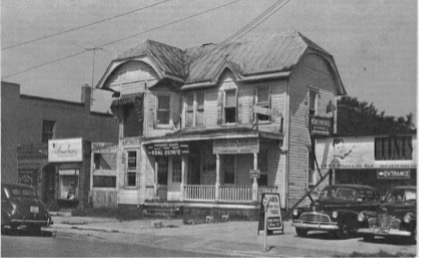
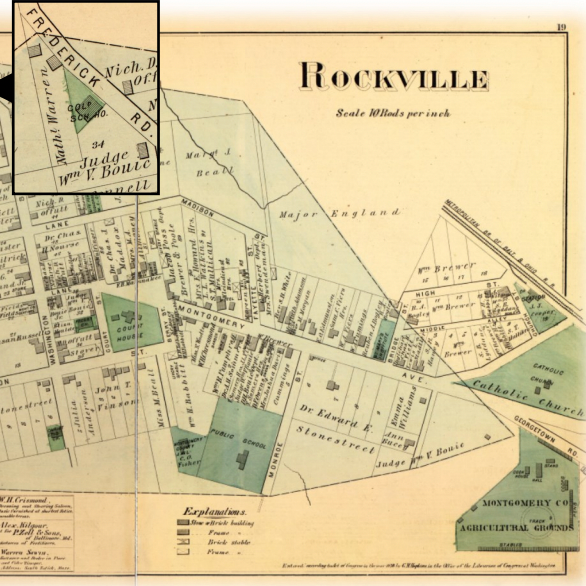
“A Pictorial History of Rockville” will be the focus of a free online presentation of Montgomery History at 2 p.m. on Tuesday, Aug. 9. Ralph Buglass will lead the discussion. The presentation will draw extensively on vintage photos from “Rockville: Images of America,” a book produced by Peerless Rockville and coauthored by Mr. Buglass. It will cover the 250-year history of Rockville and will look at how Rockville grew from a tiny crossroads community to the bustling government center of Montgomery County—and one of the nation’s most diverse cities.

Mr. Buglass often speaks about many aspects of Montgomery County history. He has a bachelor’s degree in American history from Cornell University and a master’s in journalism from American University. To register for the presentation, go to https://us02web.zoom.us/webinar/register/WN_8accXj9CRD6PytAnLLnpbA. “Drawing extensively on vintage photos from a book produced by Peerless Rockville, this talk covers the 250-year history of Rockville from a tiny crossroads community to the bustling government center of Montgomery County—and one of the nation’s most diverse cities. Rockville not only has a fascinating history all its own, but also exemplifies our county’s history in many ways—and has ties to significant national events and figures. The speaker co-authored the book for Peerless Rockville.”


Mae was a pioneering milliner who was famous for her custom-made hats. She was active in her field from 1940 until 1997. She passed away in 2016 at age 104.

At age 28, she opened “Mae’s Millinery Shop,” located at 1630 South Street in Philadelphia. By so doing she became one of the first African American women to own her own business in downtown Philadelphia.


View More Stories