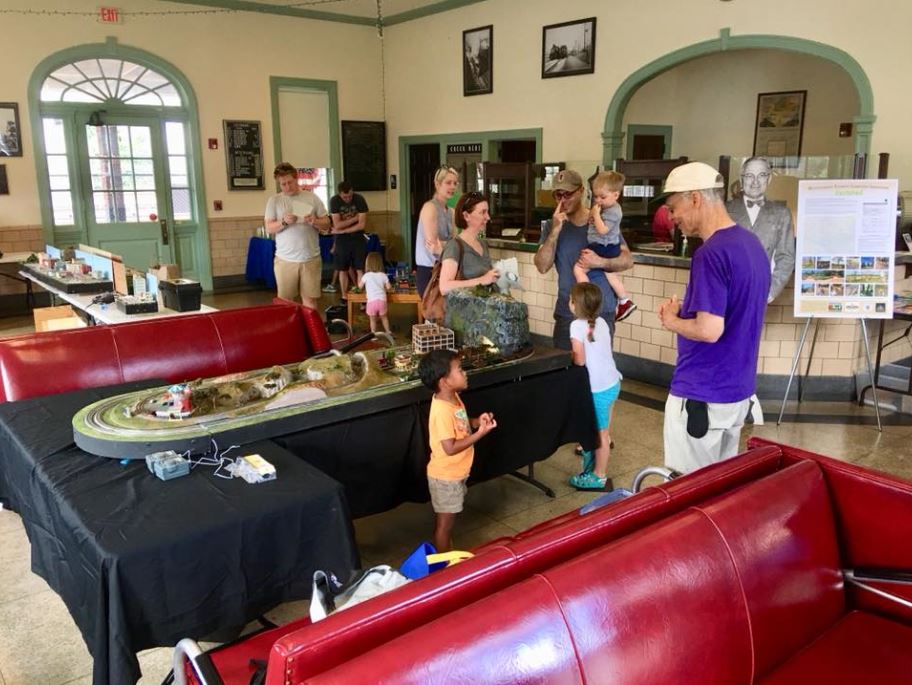
Burned down in the 1970s, Germantown Train Station was rebuilt to its 19th century splendor, the vision of a famous Baltimore architect.

Today, Germantown Train Station is used as a waiting room for commuters and has a coffee shop, Alafia Crossing, operated by Bota King. More than 800 passengers board the trains that leave the MARC (Maryland Area Regional Commuter) train in Germantown every weekday morning, a stop along the Brunswick Line that travels from West Virginia to Washington, DC.CSX Transportation owns this line of rail. But the tracks used to be part of a Baltimore & Ohio network dating back to the 19th century.


ROCKVILLE, Md., June 10, 2022—Montgomery County Councilmember Hans Riemer will join community leaders and the Department of Parks on Sunday, June 12 to announce renovation plans for Johnson’s Local Park, once Montgomery County’s thriving home field for Black Baseball sandlot teams and a center of community gathering in Emory Grove.

The announcement will be made on Sunday, June 12 at 1:45 p.m. prior to the 1st Annual Clarence ‘Pint’ Isreal Juneteenth Classic between the Bethesda Big Train and Gaithersburg Giants of the Cal Ripken Collegiate Baseball League, at Shirley Povich Field. Pint Isreal was a Negro League baseball player from Montgomery County who played at the sport’s highest levels. Isreal was recently selected by the Montgomery County Sports Hall of Fame as a member of their 2022 Class of Inductees.


The peace of the little village of Germantown was broken by the sound of gunshots on January 20, 1932. Robbers had entered Horace Waters’ store at around 7 p.m. They shot and killed Mr. Waters, a prominent citizen of Montgomery County, and wounded his clerk

Horace Waters was known to carry a large amount of cash, and often loaned money to local people in need, both white and black. He operated a general store in Germantown at the corner of Germantown Road and Clopper Road for more than 50 years. A grandson of one of the first settlers of the area, William Waters, Horace was a director of the Farmer’s Banking and Trust Company of Rockville and well respected in the community.


The MCPS website now contains information for students, staff, parents, and community members, but it only started 27 years ago. Below you’ll see a brief history of “MCPS Web”, courtesy of MCPS:

March 14, 1995: In the beginning there was a DEC Alpha server running the Unix operating system and the Netscape web server. David Kreisberg, with the help of a small group of brilliant Blair High School students, brought the server to life and created the first web pages in March, 1995.


Today we call all places where people are buried cemeteries, but it is actually a fairly recent term that first appeared in America in the 1830s with the first corporate Memorial Parks. Before that there were burial grounds—municipal burial grounds, churchyard burial grounds and family burial grounds. Burial grounds are sacred places. They mark where our ancestors lie, commemorate the special, and memorialize the unique, but they are also primary sources that can tell us about birth and death dates, where a person lived, who was related to whom, and social customs surrounding death and burial.

In the 18th and 19th centuries, when Montgomery County was still frontier or at least very rural, people died they were buried on thier property when they died. Almost every farm had its own burial ground. In towns and urban areas, the dead were buried on church or town property in churchyards or graveyards. As cities and towns grew, these places for the dead grew overcrowded and at the same time people began to realize that decaying matter spread disease. So, the burial grounds had to move outside the city. Official Cemeteries were established outside cities and towns beginning in the 1830s. These were either voluntary associations or private, often for-profit, corporations. The organization would purchase the land then sell burial plots, keeping a trust fund for future upkeep. Sometimes these cemeteries were created as parks, landscaped with exotic trees and flowers and having wandering paths, benches and gazebos creating a pastoral atmosphere for the “contemplation of death and life.” Lovers strolled and families picnicked in these park cemeteries.


Kensington’s history began as Joseph’s Park through a land grant of 4,220 acres, located at the time within Charles County, to Mr. William Joseph in 1689. Permitted on September 25, 1705, and now within Prince George’s County, William Joseph’s son used the land for agriculture until he sold it in 1736 to Mr. Daniel Carroll of Upper Marlboro. Carroll, who was one of only five men to sign both the Articles of Confederation (1777) and the Constitution (1787), sold various parcels of land to local farmers. Kensington’s current day form came about from Mr. George Knowles’ property following the construction of the Metropolitan Branch line from Washington, DC to Point of Rocks in 1873.

Bisecting Mr. Knowles’ property, the train began stopping in 1891 at Knowles Station to participate in commerce with Mr. Knowles and the other local farmers. Taking this into account, Mr. Brainard Warner purchased property south of Knowles Station in 1890 from the Brown family and built a summer retreat home. Mr. Warner then began encouraging his friends to purchase parcels of land from him so that they could build summer homes as well. Mr. Warner’s property became known as a “garden suburb” in which he designed after Kensington, England.


By Susan Soderberg of the Germantown Historical Society

It was just before the election in 1920 and several men were gathered informally at the Waters General Store in Germantown discussing the pros and cons of the various candidates. When it came up that a local citizen, John Bolton, was refusing to vote, one of the men, Guy Vernon Thompson, volunteered to try to persuade him to do his civic duty.


The presentation spans a cross-section of automobile history across the State, from the earliest cars and paving of The National Road to post-war leisure travel and the opening of the Chesapeake Bay Bridge


You’re invited to Explore Rockville’s long and rich history  through a self-guided outdoor tour and scavenger hunt that will walk you through sites and stories in Rockville through the decades. Learn about Rockville from its beginnings to the 20th century, and visit parks and public art along the way, in this event by Peerless Rockville.

Per the event listing: Tour stops are a SURPRISE! The 10+ stops about Rockville’s unique sites, stories, and art are located across the city – you’re invited to explore places you’ve never been and sites you pass by all the time unaware. This tour features highlights from our three previous Explore Rockville events plus a few new stops.


Montgomery County’s first AAPI Heritage Project is examining the history of AAPI county residents as early as the 1900s By Karen Yee, published on MontgomeryPlanning’s Department Blog

Of the 86,000 sites listed on the National Register of Historic Places, the nation’s repository of historic structures, sites, buildings, districts and objects that are deemed significant to American history, less than 8% relate to Asian Americans and other underrepresented communities. In Montgomery County, where 15% of residents are Asian American and Pacific Islander (AAPI), there is only one locally designated resource associated with AAPI heritage, the Pao-Chi and Yu Ming Pien House. Even this house was only recently recognized—it is located within the Potomac Overlook Historic District, designated in April 2022. In order to address this disparity, Montgomery Planning’s Historic Preservation Office applied for and was awarded a non-capital grant by the Maryland Historical Trust in 2021 to identify historical and cultural resources associated with AAPI communities in Montgomery County.


‘I Have Started for Canaan: Telling the Sugarland Story” will be available for viewing through May 16. No registration is required.

The panel also will describe ongoing preservation efforts and speculate about some of the intriguing historical questions that remain to be explored about Sugarland.


View More Stories