

By Ben Shlesinger
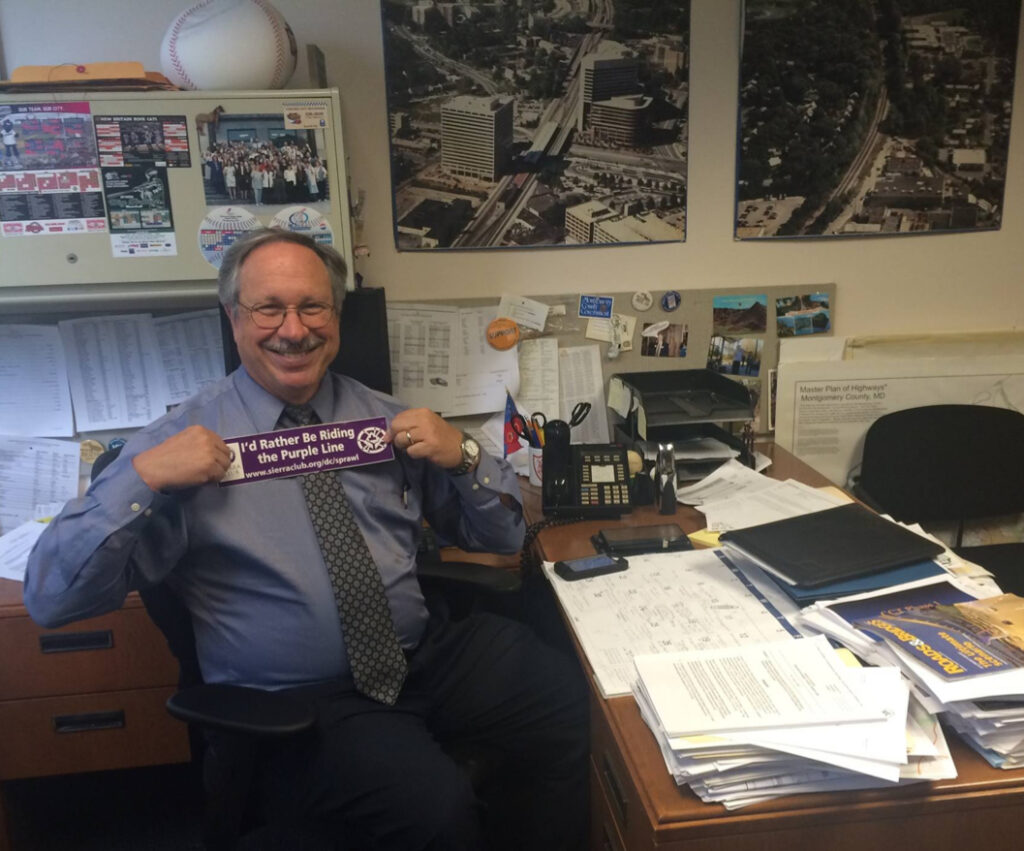
Last December Dr. Glenn Orlin retired after working in Montgomery County for 39 years, the first six with the Department of Transportation followed by 33 with the County Council. For most of his career with the Council he served as its Deputy Staff Director and transportation analyst, acting as the main resource for the Council and its staff on anything and everything related to transportation.
“My former Staff Director always hated it when I said this outloud, but I felt like I worked for 19 people: the [then] nineCouncilmembers and their confidential aides, and the Staff Director,” Orlin said. “When you work for 19 people you’re not unduly influenced by the mood or attitude of any one individual. If one were upset with you one week, he or she wouldn’t be by the next week.”
Orlin appreciated the flexibility his position afforded him in that he could talk to anybody he wanted at any time. He could speakwith a County department head, County staffer, or any constituent without being restricted by bureaucratic customs.
He wishes that the public truly understood their County elected officials. “The tendency among many is to believe they are corrupt or selfish, but they don’t give them near the respect they deserve.” Orlin added, “I’ve worked with the Council since1990 and before that when I was with DOT. They’re smart people and they all want to do what they think is the right thingfor their constituents and the county as a whole. They are true public servants, and they really work their butts off.”
Of course, as the county has grown and changed incredibly since Orlin began his work, so have the transportation issues. When he first started, the largest concern was traffic congestion. It was bad then and hasn’t gotten better except briefly during COVID, he states. He adds that transportation priorities on the Council have shifted greatly over time.
“Congestion is not something the Executive and the Council cares much about anymore. “If you talk to folks on the Council or in the Executive’s office, it is mainly to promote transit use and provide much better pedestrian and bicycle safety,” Orlin said. “A third area would be promoting biking even though the overwhelming proportion of County travel is by private motor vehicles. Biking constitutes only a miniscule portion of travel, despite the County’s heavy investment in bikeways over the past 20 years. Transit ridership is down since COVID, and we are investing billions of dollars to expand it. Like it or not, driving is still going to be the main way of getting around and will be for the foreseeable future.”
Orlin said there is almost no money for building or widening roads in the County’s capital budget. Downcounty would not see such investment anyway since there is little space available for new road construction. But the lack of road funding in theMidcounty and Upcounty will continue to bedevil commuters there, who will have to deal with ever increasing congestion. “The congestion is just going to be worse and worse, but the attitude seems to be ‘Good. Maybe folks will stop driving and ride a bike or take a bus,’” Orlin said.
One might wonder what exactly Orlin will do with his time now that he is retired. Besides avoiding Montgomery County traffic, maybe he’ll catch a baseball game? Well, he is already quite prolific at that. Over almost 40 years he has visited 425 different Major League and Minor League baseball stadiums. Many of them are no longer in use. He recently attended a game in the new Hagerstown ballpark, so currently there are only six stadiums Orlin has yet to visit, four of which will be checked off the list later this year—Dublin and Davis (CA), North Platte (NE), and Malone (NY)—all will earn a pushpin on Orlin’s map. Coincidentally enough, Municipal Stadium in Hagerstown was the very first minor league stop on this stadium tour, 37 yearsago. It was built in 1930, most recently home to the Suns (a Washington Nationals affiliate) and demolished in 2022.
Orlin doesn’t always conduct this baseball odyssey alone. A former DOT colleague and friend, Bob Simpson, is trying to drive the length of every US route. There are 192 and Simpson has completed 174, including every east-west route. He also aims to visit all 429 units of the National Park Service, of which he’s been to 327 to date. Each year since 1991 (except 2020) Simpson and Orlin have undertaken a road trip, driving US routes and visiting NPS sites during the day, and ballgames at night.
So, what else can Orlin do with baseball stadiums pretty much complete? Maybe, I don’t know, cross the pond and see every English soccer stadium? The thing is, Orlin has already completed what’s called “Doing the 92”, which is to attendsoccer (“footie”) matches in each venue of Britain’s top four leagues. And this takes into account the practice of club promotion and relegation, which means teams move in and out of the leagues based on success, or lack of it. Orlin’s last match was in Wrexham, Wales, which as fans of F/X’s docuseries will note, was promoted to the fourth-tier league just this past year.
Orlin’s wife taught Shakespeare for many years and her job has taken her to London almost every summer since the mid-1980s. They eventually bought a small flat which provided the Orlinswith a home base for theatre, museums, and the 92.
National parks might be the next challenge Orlin faces head-on, but he has earned himself a break. That’s not too likely though. After nearly 40 years of working for Montgomery County andtraveling all over the United States and Great Britian visiting sports venues, with this newfound retirement free time he has, you might catch Orlin at, where else, a baseball game. ABethesda Big Train game to be specific, a team he helped found in 1999.