

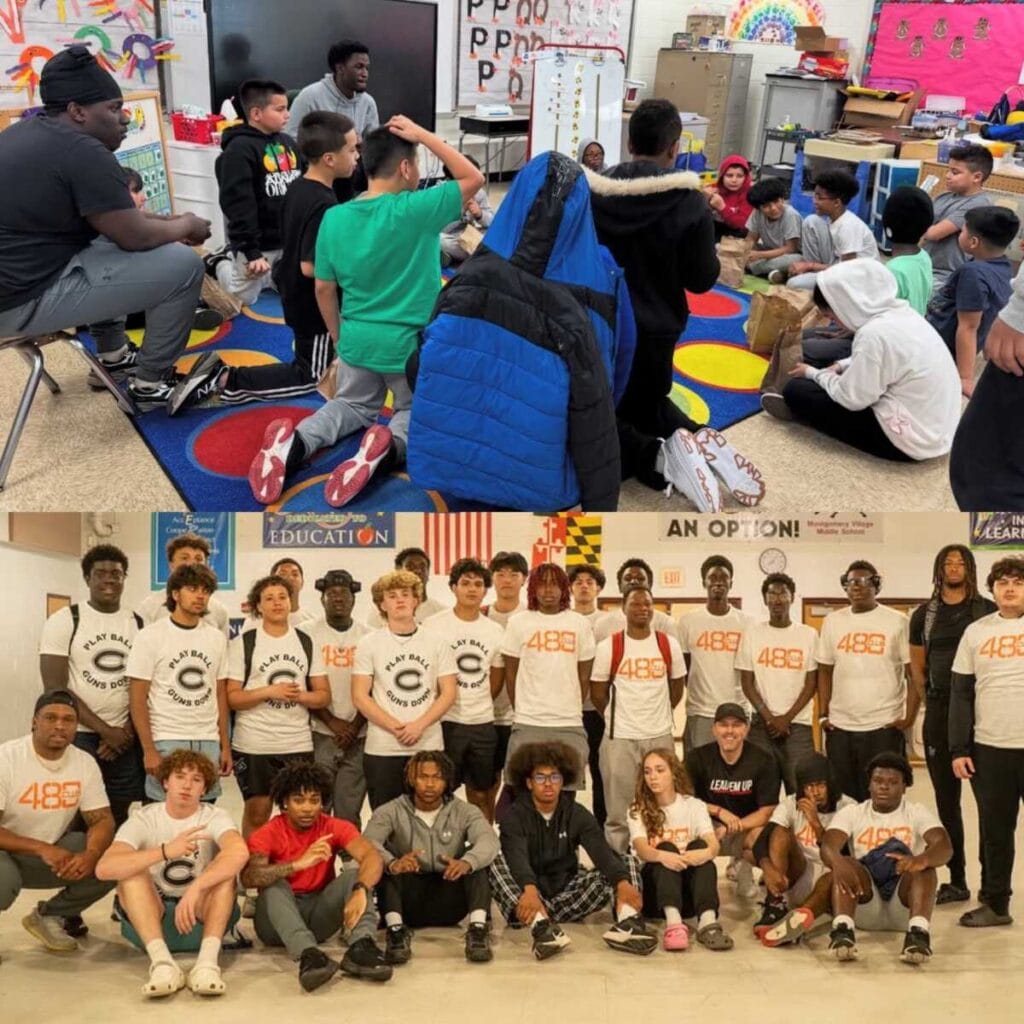
Now in its third year, Watkins Mill alumnus Joseph Hooks’ 480 Club’s Student Athlete Mentor Program (SAMP) has become one of Montgomery County’s most impactful youth-led initiatives for leadership development, community building, and violence prevention. The program pairs high school student-athletes with younger students through athletic mentorship, social-emotional learning, and consistent peer support. What began as a school-based effort is now influencing sports culture across the Clarksburg, Northwest, and Watkins Mill clusters and extending into community sports programs throughout the region.
This year’s mentors, representing Clarksburg High School, Northwest High School, and Watkins Mill High School, worked with more than 100 middle school students and dozens of elementary-aged youth. Their presence has reshaped the environments of both school-based and community athletic programs.
SAMP mentors from Clarksburg and Northwest strengthened relationships with two large community sports organizations, the Clarksburg Sports Association and the Germantown Ducks Football and Cheer program. High school mentors attended youth practices, led skills sessions, supported team culture efforts, and provided the type of steady encouragement many young athletes do not always receive. Coaches credited the mentors with helping to raise expectations and create safer, more positive team environments. Parents described the mentors as “superheroes,” noting how the energy of the field changed the moment they arrived. The partnership has strengthened the pipeline from youth sports to high school athletics by helping younger athletes build confidence, learn teamwork, and feel more connected to their community’s sports identity.
The Watkins Mill SAMP team built a direct mentoring model with three feeder elementary schools: Watkins Mill Elementary, South Lake Elementary, and Whetstone Elementary. Mentors visited weekly to provide after-school support, SEL check-ins, recreational activities, and confidence-building sessions. Staff at these schools reported noticeable improvements in student behavior and engagement, along with stronger trust between families and the school community. Many students said they looked forward to the sessions and felt happier afterward. In the neighborhoods around the schools, younger children began to recognize their mentors and see them as role models. The program helped shift the perception of student-athletes into one centered on leadership and service.
All mentors completed the Lead ‘Em Up leadership curriculum designed by Watkins Mill alumnus Adam Bradley, which focuses on empathy, communication, goal-setting, accountability, positive behavior modeling, leadership under pressure, conflict resolution, and safety awareness. This training provided mentors with the skills needed to engage younger students with confidence and compassion. Several mentors shared that the experience helped them grow personally, with one Clarksburg student saying it taught him how to lead in life, not just in sports.
To recognize their time and commitment, mentors received stipends for their work. For many, it was their first paid leadership role and served as validation of the hours spent mentoring, coaching, and representing their schools. The financial support reinforced lessons about professionalism and responsibility that are core to the program.
SAMP also provided memorable enrichment opportunities through exposure trips to the Baltimore Ravens and the DC Defenders. These outings gave both mentors and mentees the chance to experience college and professional sports environments, meet athletes, and envision future pathways for themselves.
Survey data from Year 3 showed overwhelmingly positive results. Ninety-eight percent of mentees reported feeling safer and more connected, more than 90 percent said mentors helped them make better choices, and all reported increased engagement in school or sports programs. Mentors also experienced significant personal growth, with reported improvements in wellness habits, mental health, and communication skills. Many younger participants said they now hope to become mentors themselves. One Watkins Mill elementary student summarized the program’s impact by saying, “My mentor makes me feel like I matter.”
By uniting high schools, feeder schools, and community sports organizations, the Student Athlete Mentor Program has created a countywide ecosystem of youth leadership. High school mentors are developing into strong leaders, younger students are gaining confidence and connection, families are receiving broader support, and schools and coaches are seeing improved participation and behavior. SAMP, created by Joseph Hooks of the 480 Club and supported through leadership training by Lead ‘Em Up, continues to demonstrate that when student-athletes lead with purpose, the entire community benefits.


