The National Weather Service (NWS) has issued both a Special Weather Statement and a Hazardous Weather Outlook for the Baltimore and Washington metro areas, warning of potentially hazardous travel conditions for the Friday morning commute.
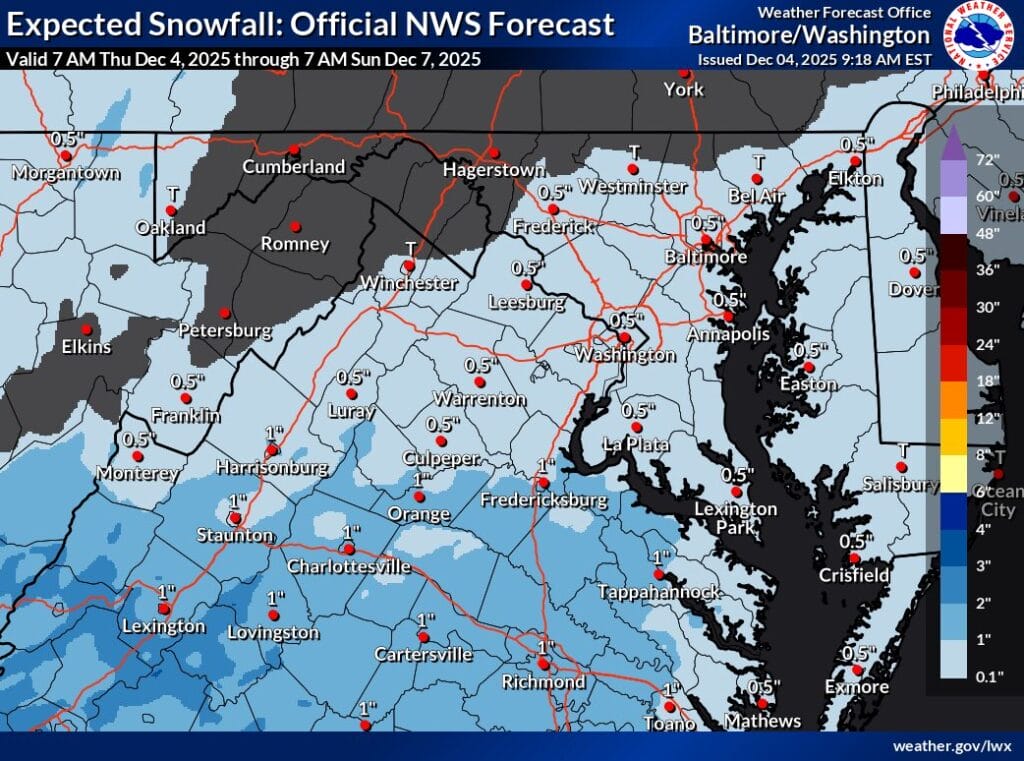
Per the NWS, confidence in snowfall totals remains moderate, with forecasters noting a 30 to 50 percent chance that a period of light snow could develop around daybreak. Current deterministic snowfall forecasts call for around a half-inch across most of central Maryland, including Montgomery County, Prince George’s County, Washington, D.C., and Baltimore, with up to one inch possible on untreated roads. This aligns with the Special Weather Statement’s emphasis on light but potentially impactful accumulation.
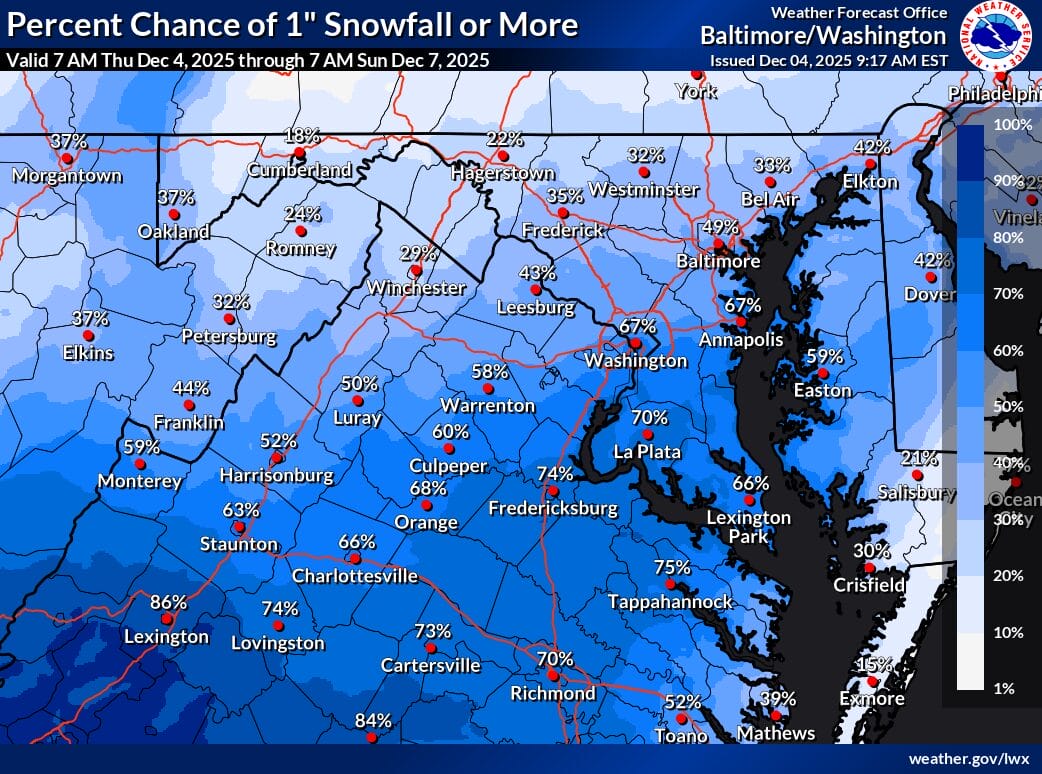
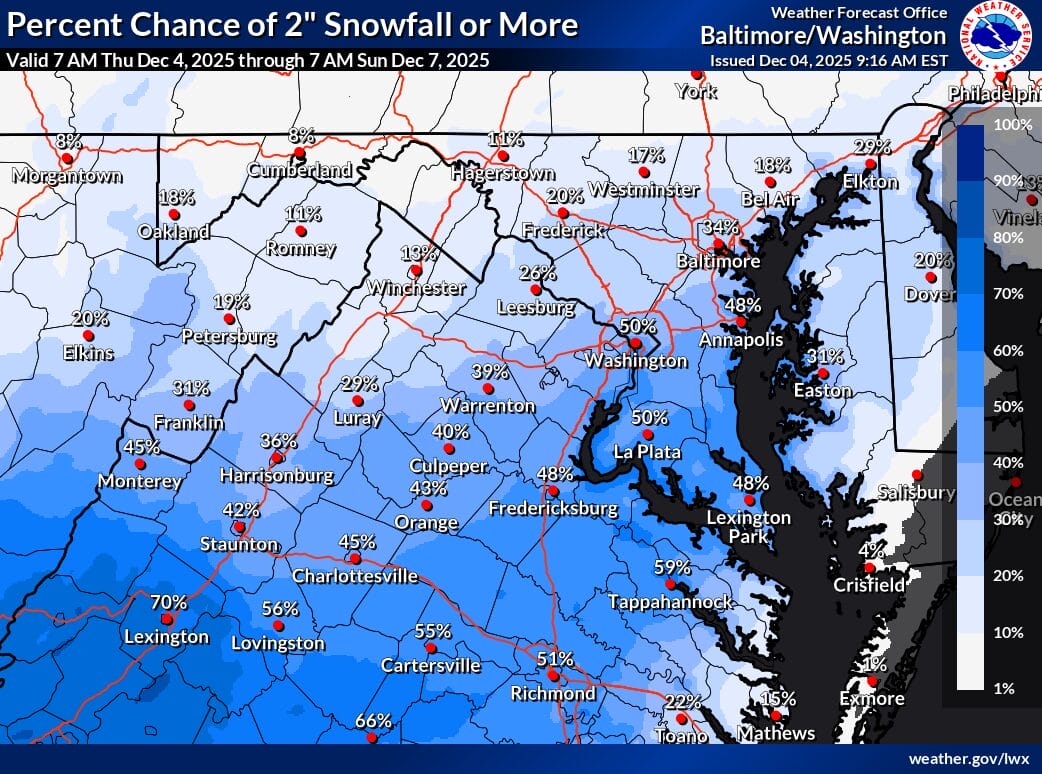
However, the NWS probabilistic maps show a much wider range of possible outcomes, emphasizing the uncertainty still in play. The region has a 50 to 67 percent chance of receiving at least one inch of snow, but only about a 20 to 30 percent chance of reaching two inches in the immediate metro area.
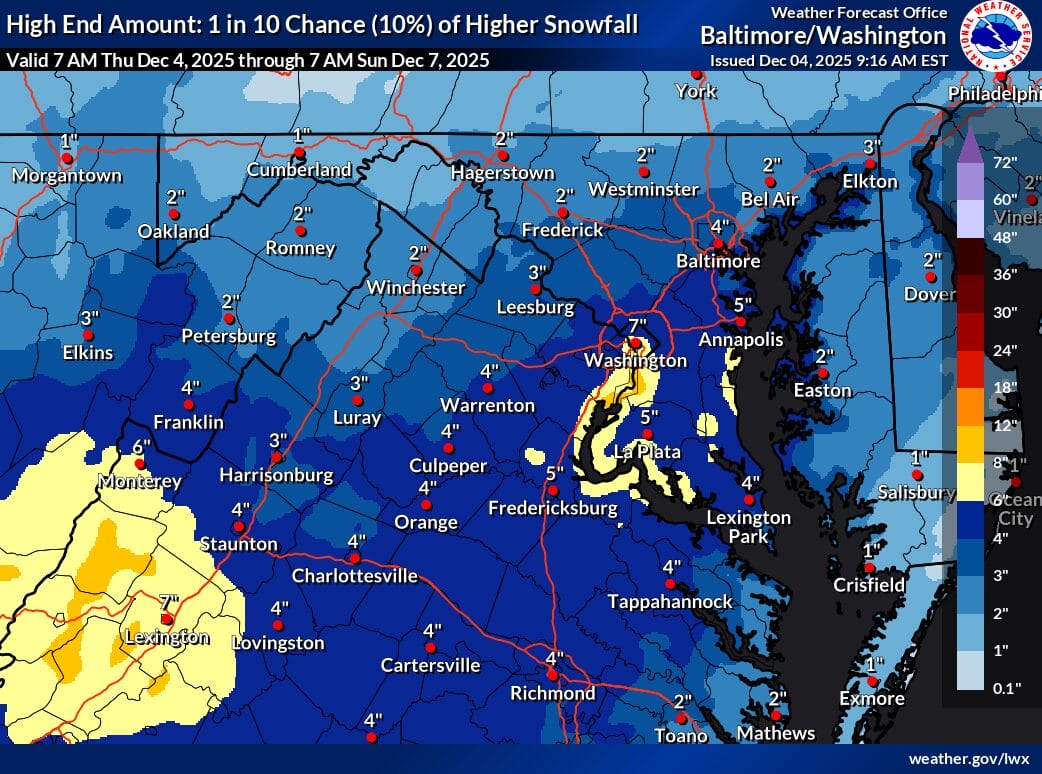
The “high-end” scenario, representing only a 10 percent chance, shows a significantly different picture, with as much as 7 inches indicated over Washington, D.C., and 4 to 5 inches in parts of central Maryland and Annapolis. While this outcome is very unlikely, the NWS includes it to illustrate what could occur if heavier snow bands form or the storm system shifts slightly north.
Because even light snow can quickly create slick and icy roads during rush hour, the NWS warns that if snow materializes during peak travel times, drivers could face dangerous conditions, multiple accidents, and significant delays. Commuters are encouraged to allow extra travel time, consider public transportation, or take advantage of telework options where possible.
The system is expected to begin Friday morning, and the NWS notes that light snow or freezing drizzle could also affect the evening commute as the storm slowly departs late Friday. The combination of modest expected totals, higher-end outlier scenarios, and timing during rush hour is the primary reason forecasters are urging extra caution.