

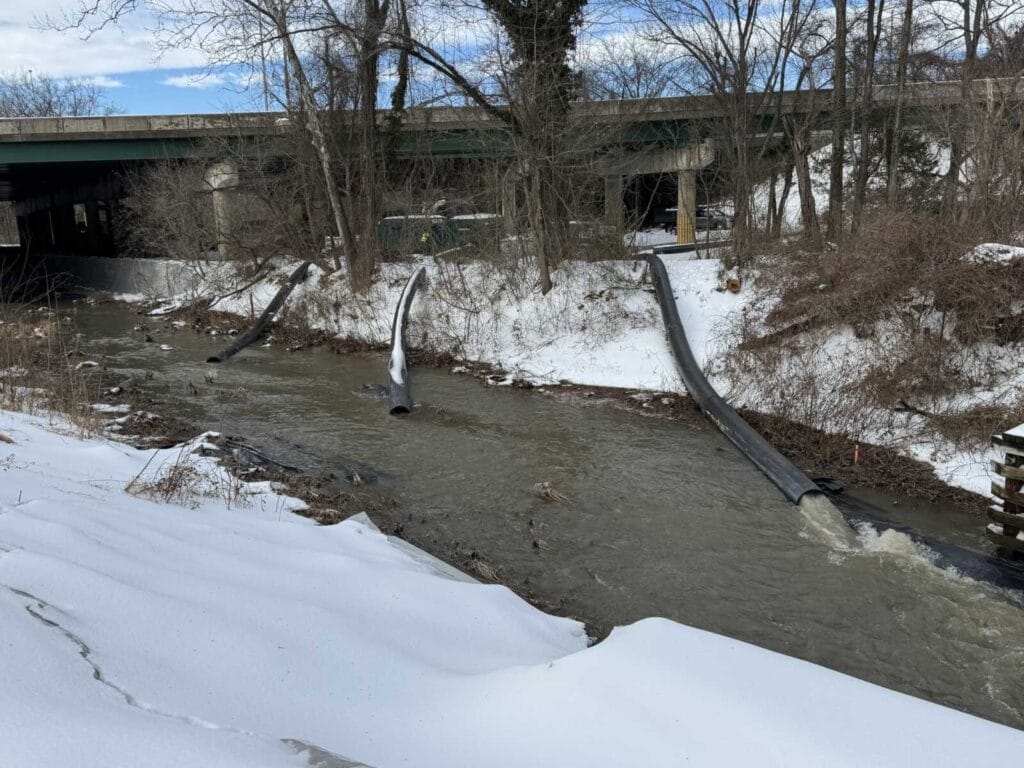
Environmental testing released this week by the Potomac Riverkeeper Network shows extremely elevated levels of E. coli bacteria in the Potomac River following the collapse of a major sewer line in Montgomery County, raising concerns about potential long-term impacts on water quality and public health.
According to the nonprofit organization, water samples collected near Lockhouse 10 along the Potomac River revealed E. coli concentrations nearly 12,000 times higher than limits considered safe for human contact. Samples were taken from the sewage discharging from the damaged Potomac Interceptor near Cabin John, nearby public river access points, and locations several miles downstream in Washington, D.C. While contamination levels decreased farther from the source, testing still showed bacteria levels well above safety thresholds. Upstream samples taken near Old Angler’s Inn showed normal conditions, confirming the spill as the source of contamination.
Potomac Riverkeeper Network officials said nearly 300 million gallons of raw sewage have entered the river since the collapse, which occurred along the Clara Barton Parkway within the C & O Canal National Historic Park. The organization attributed the incident to infrastructure failure and criticized the use of the canal as part of the emergency containment strategy, warning that prolonged exposure to untreated sewage could contribute to harmful algal blooms, fish kills, and other environmental damage.
DC Water said crews and contractors have been working around the clock to contain the overflow using a temporary bypass system designed to divert wastewater away from the damaged section of the interceptor. The system uses industrial pumps to move wastewater through a contained section of the C & O Canal and back into the sewer line downstream, where it is directed to the Blue Plains Advanced Wastewater Treatment Plant. Officials reported that wastewater flow returning to the system has increased by approximately 40 million gallons per day since the bypass was activated, significantly reducing the amount of sewage entering the river.
Cold temperatures, snow, and debris in the wastewater have complicated operations, according to DC Water, requiring frequent maintenance of pumps that can become clogged by grease, wipes, and other materials. Additional pumps are being installed to increase capacity and provide redundancy as crews work toward full containment. Some overflow continues while the system is stabilized.
DC Water emphasized that the sewage overflow does not affect the region’s drinking water supply, noting that drinking water intakes are located upstream from the damaged pipe. Residents in Montgomery, Fairfax, and Loudoun counties served by the interceptor have been asked to avoid flushing wipes or disposing of grease down drains to help support emergency operations.
The incident timeline shows the sewer overflow was reported on January 19, with investigation and planning underway the following day. Bypass installation began January 21, pump installation was completed January 23, and the bypass system was activated January 24. Monitoring and additional pump installation continued through January 26.
Public health officials continue to advise residents to avoid areas with raw sewage, follow posted warning signs, and wash thoroughly if contact occurs. DC Water said it is coordinating response and monitoring efforts with federal, state, and local agencies, including the National Park Service, Environmental Protection Agency, Maryland Department of the Environment, and local governments.
DC Water has also stated that it has allocated $625 million over the next 10 years to rehabilitate the Potomac Interceptor as part of its capital improvement program.