

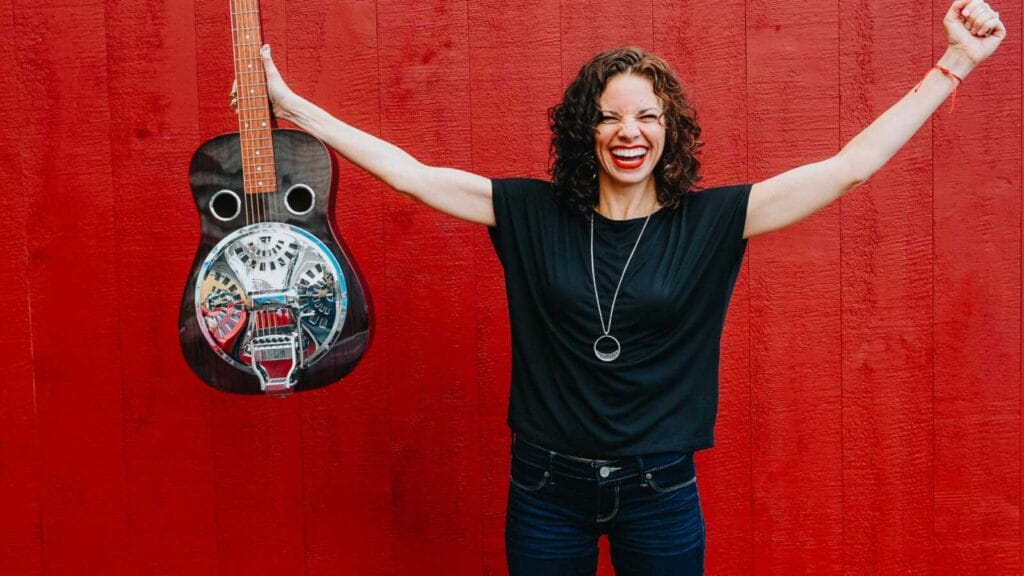
Abbie Gardner, Dobro
For more than two decades, Abbie Gardner has been known as one of the country’s masters of the dobro, a resonator-style guitar that’s popular with bluegrass and Americana bands. In the early 2000s, she earned acclaim as one of the three founders of the band Red Molly, but in the last decade Gardner has moved into rare territory as a singer-songwriter who accompanies herself solely with the dobro.
Gardner’s show at Gaithersburg’s Arts Barn on March 28 will include original songs and her unique takes on covers, punctuated with storytelling. Though she’s from Upstate New York and now lives in Nashville, Gardner has a connection to Maryland because her instruments are made at Paul Beard Guitars in Hagerstown.
Tickets: https://ci.ovationtix.com/36017/performance/11698466
Arts Barn: Tell us about the dobro.
Abbie Gardner: It is a lap-style slide guitar. You play it like you’re sitting on your lap, even though I’m often standing up when I play. It has frets like a guitar, but these strings never touch the fret board, and you just slide over them with a metal slide bar.
Dobros are also called resonator guitars: they have a resonator cone, which looks kind of like a hubcap. It’s a metal piece that functions effectively like a microphone or amplifier and gets notes resonating longer than they would with a regular guitar.
Arts Barn: What do you like about the sound?
Gardner: I like that it sounds more similar to a human voice than a guitar. I can get all the notes that are between the notes. When you listen to Norah Jones and other great singers, they can slide between notes and have all this inflection, and I can do this with my instrument too. Often I’m playing all by myself and chords or bass lines while I’m singing. Sometimes I’ll switch over and play harmony, and it sounds like I’m playing vocal harmony; it definitely would not sound the same on a guitar.
Arts Barn: How did you start with dobro?
Gardner: I started out playing classical music, the flute. I come from a musical family. I got the guitar bug in college but practiced so hard I ended up getting some tendinitis in my wrist. That made me switch over to dobro because it’s more ergonomic. Instead of your left wrist being bent, it’s in a neutral position like when you play a piano. When I started playing dobro, I was so into the sound that I stayed with it.
Arts Barn: In Gaithersburg, you are performing solo. But a lot of your recordings are with one other person or with bands.
Gardner: My last record, called “DobroSinger,” represents how the show will sound. That’s just me playing and singing at the same time. I recorded that album during the pandemic alone in my closet. A good time for a solo project.
Arts Barn: How would you categorize the types of songs you play?
Gardner: They are pretty split between two types of songs. I love songs that are pretty groove oriented. They’re more salty, bluesy. And then the others I think of as sweet songs that make you cry, real sentimental ones. For example, I recorded a cover version of “You Belong to Me,” which is real sad, and I added a little minor chord substation to make it even sadder.
I sing a lot about heartbreak, but people seem to always walk away from my shows feeling happy. I don’t know if it’s just in contrast to what I’m singing about, or if it’s because in between the songs I tell stories and I generally have a pretty joyful time when I’m performing. I think that rubs off on my audiences. If I’m playing an original song, I’ll explain why I wrote it or something about it, so that people hearing it for the first time can connect to it.
Arts Barn: Your recordings are a mix of covers and your compositions. So it seems like you have eclectic taste as a musician and as a listener.
Gardner: Yes! I like doing different kinds of covers. “You Belong to Me” is a jazz standard from the ‘50s, and I do a ZZ Top song sometimes, just different stuff that bring people in. My dad was a jazz musician, so that’s where I get all the swing influence. But I grew up listening to Ray Charles and Aretha Franklin, Bonnie Raitt and Willie Nelson. I don’t know anybody who listens to only one kind of music.
I play every single song on the dobro, and when I started doing that at my shows my friends asked, Don’t you think people will get sick of that sound? But, actually, they don’t. My voice and the acoustic sound tends to make it cohesive, and you don’t go to a show with a solo guitar player and get sick of the sound of the guitar. I try to mix it up in the styles of the songs to keep it interesting. But also I feel like it’s me at the end of the day, and that kind of pulls it together.
Arts Barn: Where does your inspiration come for your songwriting?
Gardner: I do get a lot of inspiration from reading fiction. So, I’ll write stories that are not necessarily mine. One song, “Down the Mountain,” was inspired by a book about coal mining.
Lately I’ve been mining some of my own stories, and not all of them are sad—which is nice to discover! For example, soon I will be recording a new song, “The Smoke Alarm Cookbook.” My dad had all of us kids convinced that my mom wrote a book called “The Smoke Alarm Cookbook,” and that we would know dinner be ready when the alarm went off. When I play that song, people relate to that strongly. I don’t think their dad told the same story, but we’ve all had the same moment of panic when the alarm goes off.
Arts Barn: You have a big online presence, as you sing songs, give lessons and educate people generally about the dobro. How’s that experience been?
Gardner: I’ve always collaborated because it’s so much fun getting together with other musicians, either writing songs and doing gigs. Collaborating with a musician onstage is a moment in time for you and the audience. I love that.
Covid is when I started doing more teaching, both online and then in summer music camps and Zoom workshops because I couldn’t do gigs. I had to diversify to keep doing this for a living. I kept doing it when my gigs came back because I really like the balance of not always having the focus on myself. When I’m teaching other people, I can help them with their creativity and I can step out of the spotlight for a minute. That helps put things in perspective. I enjoy watching somebody struggle with something and then have success afterwards. I always learn something about myself too.
Tickets: https://ci.ovationtix.com/36017/performance/11698466
