Clarence Kettler asked his brothers Milton and Charles to help him build Montgomery Village. Together, they created Kettler Brothers, Incorporated. The Kettlers’ vision for a “new town” was loosely based on the corridor cities concept envisioned in Montgomery County’s General Plan. The new town movement started in the United States after World War II and was, in some instances, a response and a remedy to overcrowding and congestion in urban areas. New towns were synonymous with “planned communities” – places that were carefully, purposefully designed from inception, usually constructed in previously undeveloped areas, with an effort toward being self-sufficient. The Washington region is home to two of the most famous planned communities in the country – Reston, Virginia, and Columbia, Maryland.
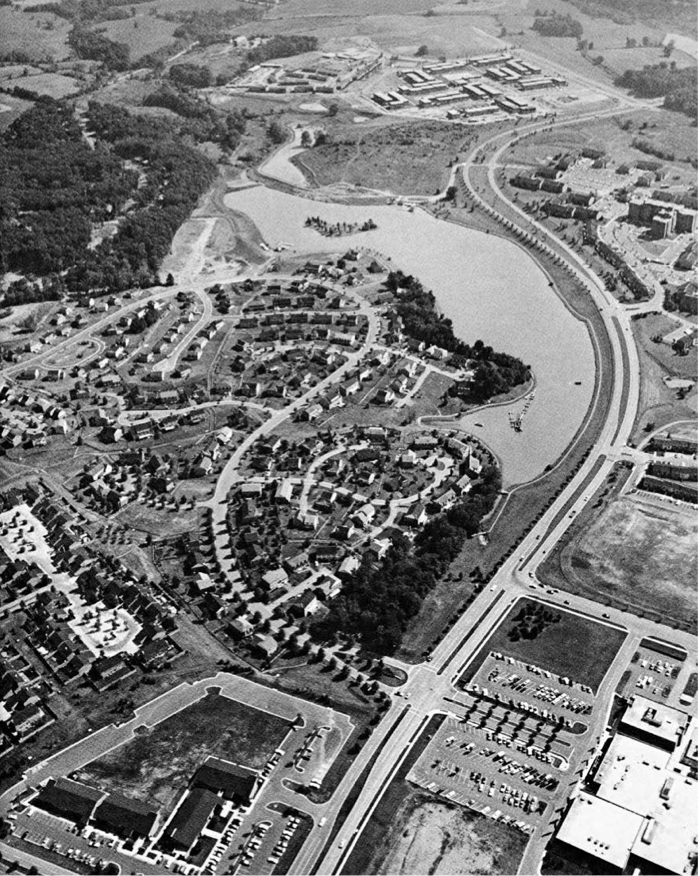
In the 1960s, the Kettler Brothers started buying farmland in the Gaithersburg area and eventually assembled more than 1,500 acres. In 1962, the Kettlers purchased the 412-acre Walker Farm adjacent to the City of Gaithersburg. This farm was their largest single property acquisition and where Montgomery Village started. Like many developers, the Kettlers named many new subdivisions in the sprawling “village” after the original farms: Walker, Thomas, Brothers Mill, French, Patton, Fulks, and Wilson. The Walker farm was developed into numerous residential communities – Walkers Choice, Cider Mill, Dockside – as well as a library, a day care center, South Valley Park, and the Montgomery Village Plaza retail center. In addition to memorializing the former farms, the Kettlers attempted to instill a sense of community identity in the names; for example, the “choice” in Walker’s Choice was meant to convey that this was a rental community; some units have since become condominiums. Stedwick means “the meadow,” or “the land that was a dairy farm.”