

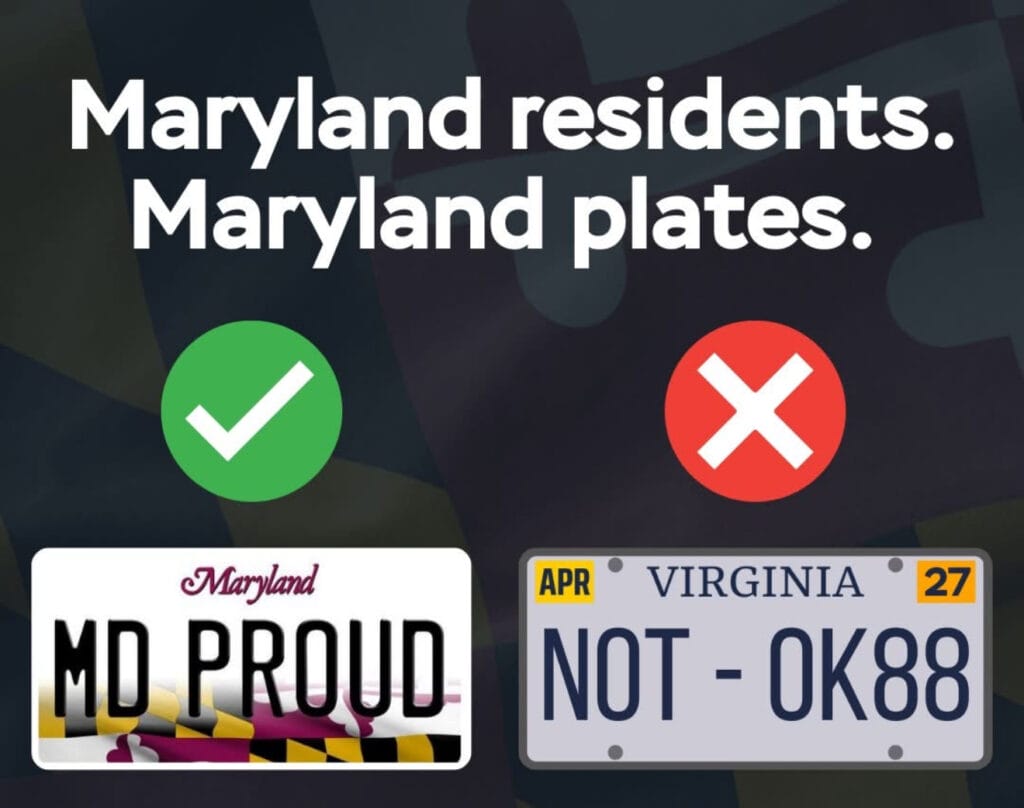
The Maryland Motor Vehicle Administration is once again warning residents that vehicles owned by Marylanders must be registered in Maryland, as the state steps up efforts to crack down on license plate fraud involving Virginia tags.
On Wednesday, the MVA shared a message on social media stating, “Think you’re saving money? Maryland is working in partnership with Virginia to curb license plate fraud. If you live in Maryland, your vehicle must be registered here.”
The renewed warning follows a February 13 update in which the MVA said more than 58,000 Maryland residents had already received notifications about vehicles that were illegally registered in Virginia. According to the agency, those registrations violate Maryland law, which requires residents to title and register their vehicles in-state.
The issue is not new. Last year, the MVA cautioned that driving with an out-of-state registration as a Maryland resident is illegal and can carry serious consequences. In one post, the agency emphasized that driving without a valid registration is a criminal misdemeanor and warned residents that attempting to avoid fees is “not worth the risk.” The MVA also encouraged people to report suspected violations to state investigators or local law enforcement.
For years, the practice has been driven largely by cost differences between the two states. Virginia’s vehicle registration fees are significantly lower than Maryland’s, and until recently, Virginia allowed drivers to pay an uninsured motorist fee instead of carrying auto insurance. That policy created a loophole that Maryland residents could exploit, allowing them to legally obtain Virginia plates while driving without insurance, something that violates Maryland law.
In our September 2025 update, it was noted that Virginia’s DMV did not require proof of Virginia residency to register a vehicle. That made it easy for Maryland residents to use a friend’s address or a P.O. box in Virginia to obtain plates. The MVA has estimated that as many as 111,000 vehicles with Virginia tags were linked to Maryland addresses, resulting in a potential loss of up to $12 million in revenue each year.
A key shift came when Virginia changed its registration rules to require proof of insurance, effectively eliminating the uninsured motorist fee option. State officials expect that move to significantly reduce the number of Maryland residents illegally registering vehicles in Virginia, though it may take time for the full impact to be seen.
